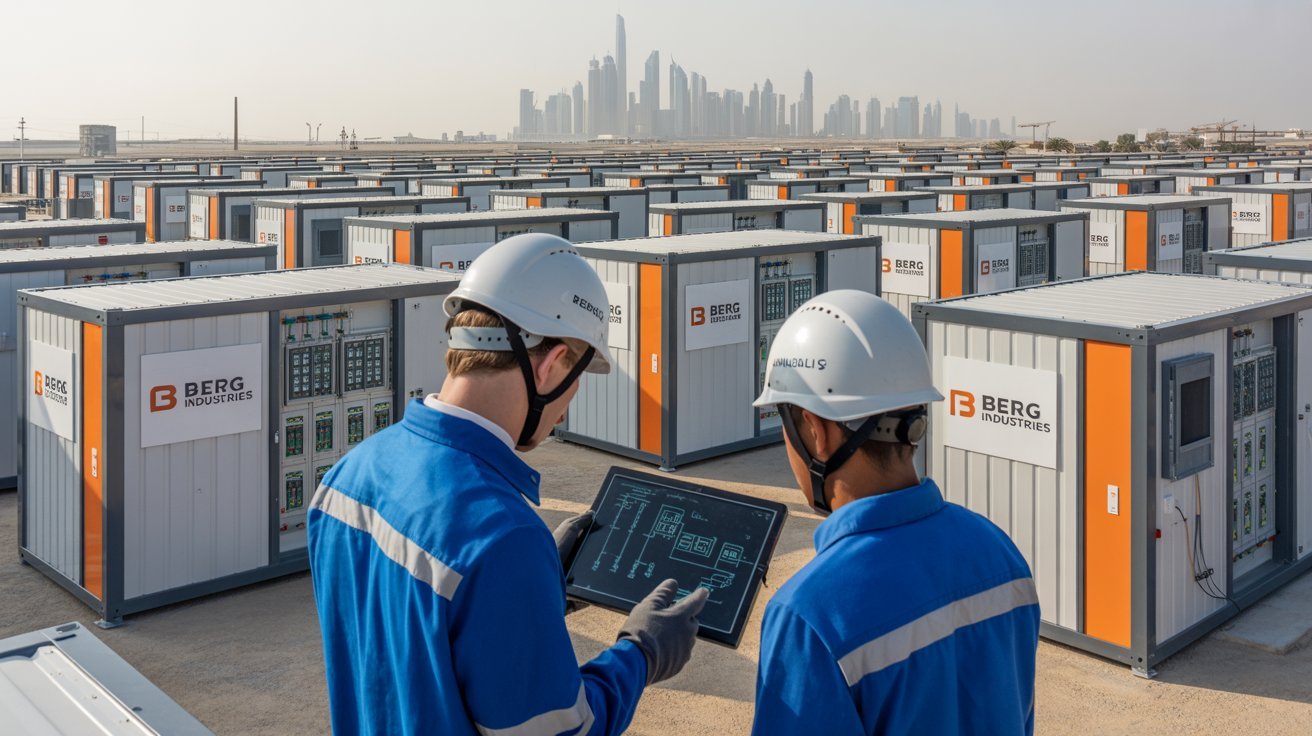
Electrical infrastructure serves as a foundation in the high-stress environment of petroleum development, where safety, reliability, and fast-tracked deployment are crucial. This isn’t just an opportunity; it means powering pumps, compressors, control systems, and mission-critical equipment in remote or harsh environments, which in turn adds to the demand for strong and flexible solutions. E-House (Electrical House) systems come into the frame at this point. These integrated, compact electrical solutions are made to integrate the electrical and automation equipment into a single, protected space.
Though E-House for Petroleum Development was once a fashionable choice, it has now become an operational necessity. E-House application in oil and gas is causing a paradigm shift in electrical infrastructure across the upstream, midstream, and downstream sectors.
What is an E-House?
E-House is a module or building that includes switchgear and motor control centers (MCCs), variable frequency drives (VFDs), transformers, and a SCADA system. They are entirely prepared, tested, and integrated, supplied to the site as ready-to-use sections, which also significantly minimizes installation and onsite work.
Can be engineered as permanent or transient installations, exactly to specification for any harsh environment; from explosive zones, marine environments, to desert realities.
The Importance of E-House Solutions in Petroleum Development
Petroleum development (PD) is characterized by locations that are often remote, manifestations in extreme weather zones, and high risks involving several variables. Conventional brick-and-mortar substations and control centers are costly and take time to build, and are sometimes not feasible at all because of environmental and logistical reasons. Modular electrical houses for oil & gas address these problems by providing mobility, speed, flexibility, and reliability.
Here is how E-House for Petroleum Development works:
Accelerated Project Timelines
The petroleum development process is a race against time, especially during exploration or plant commissioning periods. Prefabricated E-House units are used before doing civil work on-site. Such a parallel construction method shortens lead times substantially, oftentimes by as much as 40–50%.
Mobility and Scalability
Oil fields change and grow, and when they do, their operational requirements can change. Moving, upgrading, or scaling an E House requires very little, making for an extremely forward-focused infrastructure. Its modularity enables it to scale without requiring a complete redesign.
Extreme Environment Durability
For example, petroleum locations operate under some of the toughest conditions: the corrosive conditions present offshore, arctic cold temperatures, and high ambient desert environments. E-House for Oil & Gas | E-House for Petroleum Development is designed for durability. The units can be climate-controlled, fire-rated, and explosion-proof (ATEX/IECEx compliant if required).
Reduced Onsite Labor and Risk
Conventional power structures demand craftwork onsite, escalating safety threats and logistics expenditures, particularly in dangerous locations. E-House systems, on the other hand, are pre-wired, factory-tested, and ready for plug-and-play. This reduces the need for human activity on-site by a significant margin.
PD electrical integration
This high level of kinetic energy in electrical and control systems interdependent in petroleum development. An E-House is properly designed for the PD electrical integration, enabling transformers, LV/MV switchgear, protection relay, control panel, and communication interface all under one roof.
Improved Reliability and Maintainability
Since E-House applications come with climate-controlled, standardized, and factory-made architecture, they are known to provide consistent performance and simplify maintenance protocols. The need of the hour in oil and gas operations, where downtime costs them real money, is this consistency.
Core Components and Customization
E-Houses can be customized to meet the technical and environmental requirements of any given project. Core components usually include:
- MV/LV Switchgear and Distribution Boards
- MCCs and Drives
- UPS Systems and Battery Banks
- HVAC Systems
- Fire Suppression and Gas Detection
- Remote Monitoring and SCADA Panels
In the case of petroleum development, customization could also mean blast-proof walls, pressure relief panels, custom cable entry systems, seismic resistance, or world-class marine-grade construction for offshore deployment. These improvements facilitate compliance with industry-relevant established codes such as IEC, ANSI, API, and NFPA.
Understanding the Different Roles that E-House Applications Serve in Oil & Gas
Modular electrical houses for oil & gas are deployed at various points of petroleum development, specifically,
Upstream: Drilling platforms, Wellheads, Offshore rigs
Midstream: Compressor stations, pipeline monitoring, pump stations
Downstream: Refineries, natural gas processing units, and petrochemical plants.
Modular electrical houses for oil & gas deliver the reliable and secure electrical distribution to where it is needed most, whether it be a floating platform in the Gulf, a desert field in the Middle East, or an arctic pipeline corridor.
Cost and Operational Benefits
While an E-House application could be a capital-intensive venture, the total cost of ownership is well worth the initial investment:
- Earlier commissioning: Faster ROI
- Less exposure to risks arising from limited work on-site
- Reduced construction time due to factory control
- Improved safety compliance via embedded certifications
- Modular Replacement and Diagnostics Optimized Maintenance Costs
These benefits clearly match the cost-sensitive and safety-driven nature of petroleum development projects.
E-House Solutions: Future-Proofing Petroleum Projects
Oil and gas production requires the deployment of durable, rugged, safety-neutral, resilient, adaptable, and flexible infrastructure. E-House solutions tick all of the above boxes. Their benefits are exquisitely matched to the operating realities in the oil and gas business, from serious environmental accommodation to simple commissioning.
And that’s where E-House for Petroleum Development fills the gap between engineering challenges and field practicality by supplying small, full-integrated, scalable power infrastructure.
It’s not about just finding anyone; what matters when reliability and safety are non-negotiable is collaborating with an expert. Berg Industries designs, engineers, and fabricates custom high-performance prefabricated E-House units for the oil and gas industry. We ensure your electrical infrastructure is as robust and nimble as your petroleum operations.
FAQs
How big is a prefab E-House?
Sizes can differ widely based on the use case. The length of an E-House unit can vary from just a couple of meters to over 20 meters. For larger projects, it is common to assemble multiple, interconnected modules to create an integrated powerhouse.
How is PD-Electrical integration ensured through E-Houses?
They also have all the control, protection, and distribution components for PD electrical integration installed, tested, and certified in one factory by design. Many guarantees compatibility, minimized errors, and faster commissioning.
How quickly can you assemble an e-house onsite?
Installation only takes a few days once on-site, from cables to testing systems. Prefabricated E-House units can be deployed in a fraction of the time of traditional construction (which can take months).