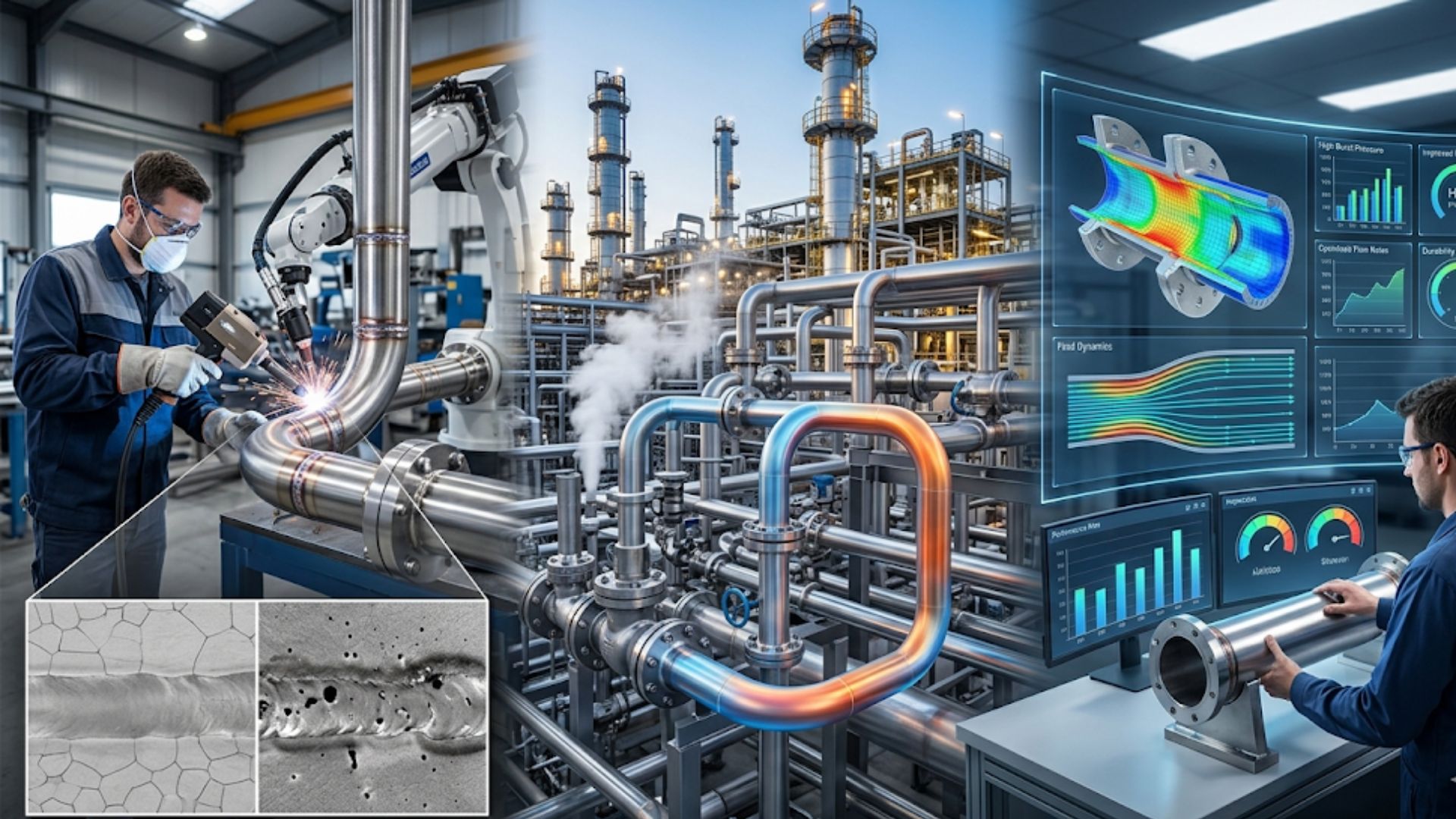
Three completed carbon steel spools were pulled from the dispatch queue at a Sharjah piping fabrication shop in early 2026, two days before their scheduled site delivery. Every weld had cleared radiographic testing. The hold was not for quality: heat numbers had not been transferred from the parent pipe lengths to individual cut pieces before processing began, breaking the material traceability chain required by the project’s inspection and test plan.
The spools returned to documentation review. The installation sequence slipped four working days.
That outcome illustrates a consistent characteristic of piping fabrication as a discipline. Technical execution at the welding stage is necessary but insufficient on its own. The workflow surrounding it, covering material receipt, traceability, procedure qualification, NDE, pressure testing, and handover documentation, determines whether a correctly welded spool reaches the site with everything needed to clear inspection. A gap at any stage produces delays that no subsequent rework fully recovers without cost to the programme.
This blog covers the end-to-end workflow for oil and gas piping and industrial piping systems, from isometric review through to spool delivery and handover documentation, mapped against ASME B31.3 requirements and UAE project inspection standards.
How Piping Fabrication Begins: Isometrics, Material Take-Off, and Traceability
The starting point for any piping spool fabrication scope is the isometric drawing package. Piping isometrics are single-line drawings defining each spool’s geometry, dimensions, material specification, weld joint locations, and NDE requirements within the project’s piping line class. Before any material is ordered or cut, the fabrication team reviews the isometric package against the project’s piping line list and material specifications to confirm the drawing set is complete, the revision status is current, and the materials called out are consistent with the approved line classes.
The material take-off (MTO) is generated from the isometric package: a compiled list of every pipe section, fitting, flange, and specialty item required for the fabrication scope, listed by size, schedule, material grade, and end type. The MTO drives procurement. For oil and gas piping fabrication UAE projects, the standard base material for carbon steel seamless process pipe is ASTM/ASME SA-106 Grade B. SA-333 Grade 6 applies to low-temperature service where the minimum design metal temperature falls below the impact test exemption threshold for SA-106. For stainless steel process piping, SA-312 Grade 316L covers corrosive and chemical service duties. Duplex piping in high-chloride and produced water service is specified to SA-790 for seamless pipe.
Once material arrives at the fabrication shop, traceability must be established and maintained through every subsequent operation. Each piece of pipe, fitting, and flange carries a heat number from the mill, linking the physical material to the mill test report (MTR) that confirms its chemical composition and mechanical properties against the applicable ASTM or ASME specification. That heat number must be transferred to every cut piece before cutting begins. When a spool is assembled from multiple cuts, every component must trace back to a confirmed, reviewed MTR. For oil and gas piping fabrication projects subject to third-party inspection in the UAE, material traceability is a formal hold point: inspection cannot be released on a spool where any component cannot be linked to a verified MTR.
ASME B31.3 Process Piping is the governing code for oil and gas and industrial process piping across the GCC. Its requirements cover material qualification, welding procedure qualification, inspection and examination, and pressure testing. ASME B31.1 governs power generation piping. API 5L governs line pipe material for hydrocarbon pipeline transport. The applicable code for each system must be confirmed in the project specification before fabrication begins.
Cutting, End Preparation, and Fit-Up in Industrial Piping Systems
With material confirmed and traceability established, fabrication begins with cutting and end preparation. The method used and the standard to which pipe ends are prepared directly affect root weld quality and joint geometry consistency across a spool with multiple circumferential welds. These steps are upstream of welding, and their accuracy cannot be corrected downstream.
For carbon steel pipe in standard wall thicknesses, plasma cutting and mechanical sawing are the primary methods in a production shop environment. Plasma-cut ends require grinding or machining to remove the heat-affected cut edge before fit-up. For stainless steel, duplex, and nickel alloy piping, mechanical cutting or cold sawing is preferred over flame or plasma cutting to avoid heat-affected zone microstructure degradation and iron contamination at the pipe end. All pipe ends must be prepared to the weld bevel geometry specified in the applicable welding procedure specification before fit-up begins. ASME B31.3 Table 328.4.3 defines the permitted bevel geometries and dimensional tolerances for butt-welded joints in process piping.
Fit-up is the step at which the accuracy of all downstream fabrication work is established. Internal misalignment between joined pipe sections, called hi-lo, is limited by ASME B31.3 to tolerances that vary by wall thickness. A hi-lo condition outside the code tolerance, closed by tack welds without correction, produces an internal root profile that creates a stress concentration under operating pressure. For piping spool fabrication where the completed spool must align precisely with the adjacent system at site, dimensional control during fit-up must be referenced against the isometric drawing tolerances, with check measurements at each flange face before tacking is completed.
Fit-up inspection is a formal step in the fabrication ITP for coded oil and gas piping. Fit-up dimensions, alignment, and joint cleanliness must be verified and recorded before welding begins. Third-party witness points at fit-up are standard for higher-category fluid service piping under ASME B31.3 and for any piping scope where the client ITP mandates witness at this stage.
Welding Processes and Procedure Qualification for Oil and Gas Piping
Welding is the phase of the piping fabrication workflow where procedure qualification, welder qualification, and real-time process control collectively determine the mechanical and pressure integrity of every joint produced. A fabrication shop without WPS and welder performance qualification records (WPQRs) aligned to the applicable code cannot produce code-compliant welds, regardless of individual welder experience. Under ASME Section IX, which governs welding procedure and welder qualification for ASME B31.3 piping, procedures are qualified by performing test welds under controlled conditions and submitting them to mechanical testing: tensile, bend, and where required, Charpy impact testing. The WPS defines essential variables including base material P-number, filler material F-number, heat input range, preheat and interpass temperature limits, and PWHT requirements. Changes to essential variables beyond the qualified range require re-qualification before that variable combination can be used in production.
Process Selection by Material Grade and Joint Configuration
Four welding processes cover the majority of oil and gas and industrial piping fabrication work across fabrication companies in UAE operating to ASME B31.3:
- Gas tungsten arc welding (GTAW/TIG) produces the highest quality root pass on open butt joints and is the standard process for root and hot pass welding on carbon steel, stainless steel, duplex, and nickel alloy piping in process service. The internal root profile must be smooth, fully fused, and free from oxidation. Higher-deposition processes handle fill and cap passes on larger diameter pipe.
- Shielded metal arc welding (SMAW) is the most versatile manual process for shop and site pipe welding, covering a wide range of diameters, positions, and material grades through electrode selection. Low-hydrogen E7018 electrodes are standard for carbon steel P1 piping. Duplex-specific electrodes are required for duplex grades where weld metal composition must maintain the dual-phase microstructure.
- Flux-cored arc welding (FCAW) provides higher deposition rates than SMAW for larger diameter, thicker wall carbon steel pipe in downhand and horizontal positions, used for fill and cap passes where semi-automatic operation and joint access allow.
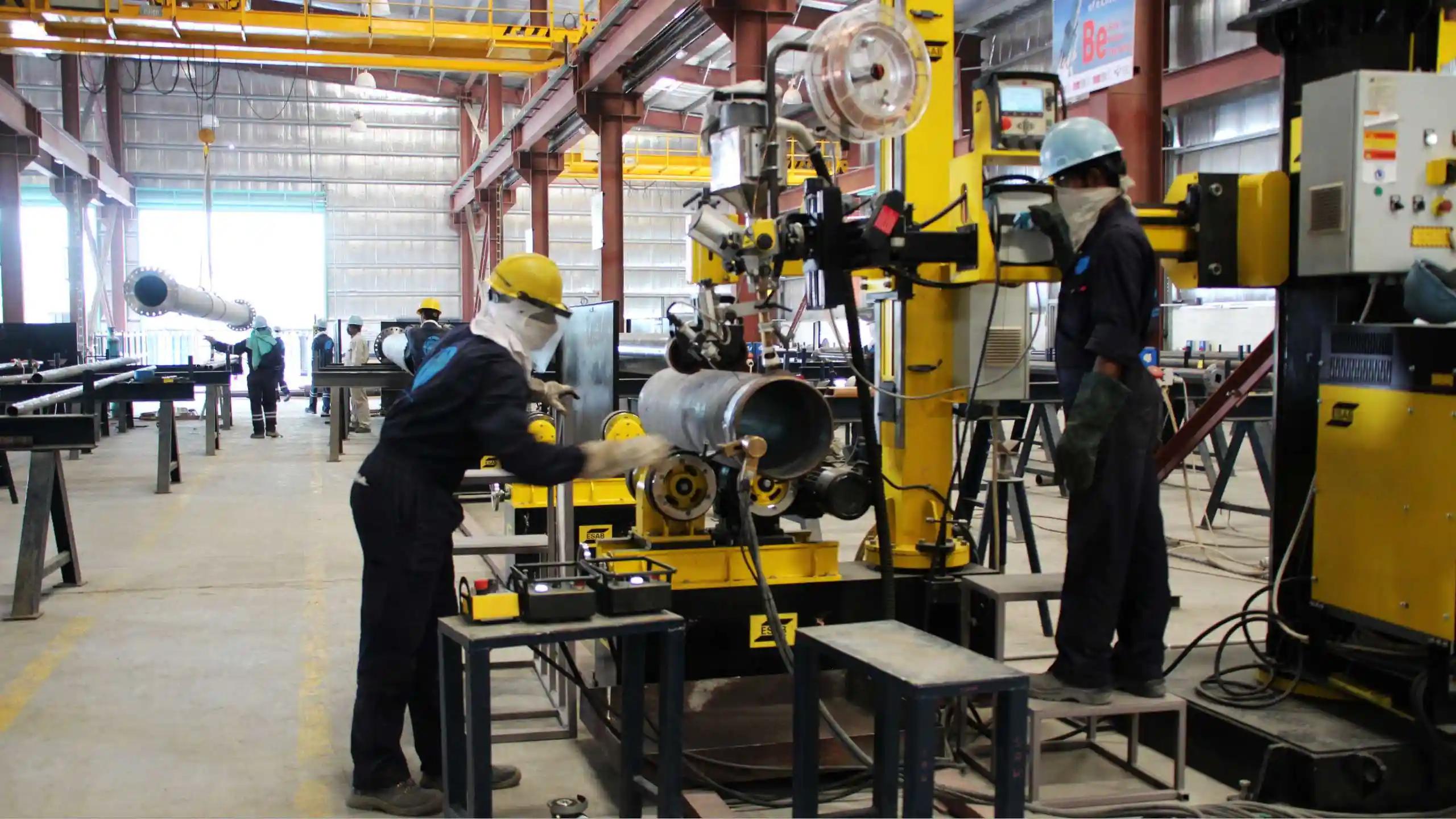
- Submerged arc welding (SAW) is applied to large diameter, thick-wall pipe assemblies and header fabrication in flat position. SAW is not used for positional welding and is limited in piping fabrication to circumferential and straight seam joints on large diameter components fabricated in a positioner.
Preheat, Interpass Temperature, and Heat Input Control
Preheat requirements for carbon steel piping are defined by the carbon equivalent of the base material, wall thickness, and the applicable WPS. ASME B31.3 Table 330.1.1 provides minimum preheat requirements by P-number and base metal thickness. For SA-106 Grade B carbon steel at wall thicknesses above 25 mm, a minimum preheat of 79°C is the standard code requirement. For Cr-Mo low alloy piping in process service, preheat temperatures of 150°C to 250°C are required depending on the specific alloy grade and wall thickness being welded.
For duplex and super duplex stainless steel piping, heat input control during welding is critical. Excessive heat input promotes sigma phase precipitation and ferrite-to-austenite ratio imbalance in the weld heat-affected zone, directly degrading corrosion resistance in service. Welding procedures for duplex grades specify maximum interpass temperature limits, typically 150°C, and heat input ranges that must be recorded on the production weld traveller for each joint. A fabrication shop without qualified duplex WPS and PQR documentation cannot fabricate duplex piping to ASME B31.3 requirements. Confirm WPS and PQR coverage for duplex and super duplex grades before placing any order involving these material specifications.
NDE, Inspection, and ASME B31.3 Examination Requirements
NDE requirements for industrial piping systems in oil and gas service are defined by ASME B31.3, the fluid service category classification, and any supplemental client examination requirements above the code minimum. UAE oil and gas project specifications routinely apply examination levels above the ASME B31.3 minimums, particularly for hydrocarbon and sour service piping. The NDE framework governs which examination methods apply, at what percentage of joints, and which hold points require a third-party inspection witness before fabrication proceeds to the next stage.
The NDE methods applied in piping spool fabrication for oil and gas service are:
- Visual examination (VT) of all welds as the mandatory code baseline, verifying external weld profile, cap width, reinforcement height, and surface condition before any other method is applied
- Radiographic testing (RT) for random or 100 percent examination of butt welds depending on fluid service category, identifying volumetric defects including porosity, slag inclusions, and lack of fusion
- Ultrasonic testing (UT), including phased array UT (PAUT), as an alternative or supplement to RT for thicker wall joints and geometrically constrained areas
- Magnetic particle testing (MT) for surface and near-surface defect detection on carbon and low alloy steel welds, applied to socket welds, fillet welds, and branch connections
- Liquid penetrant testing (PT) for austenitic stainless steel, duplex, and nickel alloy weld surface inspection where MT is not applicable due to the non-ferromagnetic microstructure of these materials
Examination Percentage and Fluid Service Category Under ASME B31.3
ASME B31.3 Table 341.3.2 defines minimum examination percentages by fluid service category. In UAE oil and gas projects, client supplemental requirements routinely specify examination levels above these minimums. For sour service piping under NACE MR0175, hardness testing of weld heat-affected zones is required in addition to the standard RT programme, confirming NACE maximum hardness compliance across base metal, weld metal, and the heat-affected zone. The table below sets out the code examination framework for the four principal fluid service categories.
| Fluid Service Category | B31.3 Reference | Minimum Butt Weld RT or UT | Additional Requirement |
| Category D (non-hazardous, low pressure) | Para 341.4 | None required | Visual examination mandatory for all welds |
| Normal fluid service | Table 341.3.2 | 5 percent random radiography | None beyond code minimum |
| Category M (highly toxic or hazardous) | Para 341.3.2 | 100 percent butt weld RT | Additional branch and socket weld examination |
| High-pressure piping (Chapter IX) | Para K341 | 100 percent volumetric, all butt welds | 100 percent examination of branch and socket welds |
Third-party inspection agencies coordinated for UAE piping fabrication projects include Bureau Veritas, TÜV Rheinland, Lloyd’s Register, and SGS. For ADNOC Group projects and UAE utility operator work, pre-qualification with the relevant inspection authority is required before inspection hold points can be formally released. The fabrication ITP for each piping package must define the specific examination percentage, NDE method, and hold or witness point status before fabrication begins.
Post-Weld Heat Treatment, Pressure Testing, and Surface Preparation
Post-weld heat treatment, pressure testing, and surface preparation are the final fabrication stages before spool dispatch. Each must be completed in sequence with formal records produced at every step. They appear as hold points in the fabrication ITP and cannot be waived without formal client and inspection authority approval.
PWHT is required for specific material and wall thickness combinations under ASME B31.3 and the applicable WPS. For carbon steel piping above defined wall thickness thresholds, and for all Cr-Mo low alloy piping in process service, PWHT is mandatory. The spool is brought to a controlled soak temperature defined by ASME B31.3 Table 331.1.1, held for a period proportional to wall thickness, and cooled at a controlled rate. PWHT relieves residual fabrication stresses in the weld and heat-affected zone, reduces hardness in NACE-controlled sour service applications, and restores Cr-Mo base material microstructure to the tempered condition required for sustained high-temperature service.
PWHT is performed in a static furnace for completed spools, or by localised induction or resistance heating on installed piping where shop PWHT is not practical. The fabrication partner must hold documented PWHT procedures covering soak temperature range, heating and cooling rate limits, and thermocouple placement requirements for the wall thickness and diameter being treated. Thermocouple trace records for each treated spool are a mandatory data book deliverable.
Hydrostatic pressure testing under ASME B31.3 is conducted at 1.5 times the design pressure, held for the period defined in the applicable inspection specification. The test record must include test pressure, test medium, duration, and witness signatures. Where hydrostatic testing is not practical due to system weight or process fluid sensitivity, pneumatic testing at 1.1 times design pressure is permitted under ASME B31.3, subject to client and inspection authority approval.
Surface preparation and coating are applied after pressure testing is complete and all NDE hold points are released. For carbon steel spools at UAE coastal or high-humidity sites, the standard preparation is Sa 2.5 blast cleaning per ISO 8501-1, followed by the epoxy primer and topcoat system specified in the project painting specification. Stainless steel and duplex spools in external atmospheric service receive pickling and passivation rather than painting, restoring the passive oxide layer and removing iron contamination introduced during welding and grinding.
Spool Marking, Documentation Package, and Site Delivery
A fabricated piping spool that arrives at site without clear marking or a complete documentation package creates inspection delays disproportionate to the effort required to prevent them. For piping fabrication UAE projects involving multiple spool packages and parallel installation fronts, spool identification and document control are active workflow requirements throughout fabrication, not administrative tasks completed at dispatch.
Each completed spool must be marked with its spool number, line number, material grade, heat number, NDE status, and any special service designation including sour service or high-pressure category. Marking must remain legible through transport and site handling: paint stencilling for carbon steel spools, stainless steel tag attachment for high-alloy spools where die-stamping on the base material is not permitted. Flange faces must be protected with plastic caps or timber blanks. Internal bores must be plugged or wrapped before dispatch.
The documentation package for a compliant piping spool or fabrication package includes:
- As-built isometric drawings marked up with any approved field changes processed through the project’s management of change procedure
- Material traceability record listing every spool component with its heat number and corresponding MTR reference
- Weld map identifying each joint by weld number with the assigned NDE method, examination result, and acceptance status
- Full NDE report package covering all examination methods applied, with RT film or digital radiographic records for each RT joint
- PWHT thermocouple trace records for each spool where PWHT was required by code or the applicable WPS
- Hydrostatic pressure test record with test pressure, test medium, duration, and witness signatures
- Dimensional inspection record confirming face-to-face dimensions, flange bolt hole orientation, and branch connection orientation against isometric drawing tolerances
- Coating and surface treatment records confirming surface preparation standard, primer application, dry film thickness measurements, and topcoat application where specified
For Berg Engineering’s pipe spool and piping fabrication scope across oil and gas, power generation, and water treatment projects in the UAE and GCC, the documentation package above forms the standard deliverable for each fabrication package released from the Ras Al Khaimah and Sharjah facilities. Spool transport dimensions and lift weights are confirmed against the site crane and access plan before dispatch. For EPC projects where pipe spools and static equipment fabrication are procured from a single partner, a unified inspection coordination framework reduces the administrative overhead of managing separate vendor data books across both scopes.
Frequently Asked Questions
What code governs piping fabrication for oil and gas projects in the UAE?
ASME B31.3 Process Piping governs oil and gas and industrial piping fabrication across UAE and GCC projects, covering material qualification, welding procedures, examination, and pressure testing. ASME B31.1 applies to power piping. API 5L governs line pipe material and welding requirements for hydrocarbon pipeline transport.
What welding processes are used in oil and gas piping fabrication?
GTAW (TIG) is standard for root passes across all material grades. SMAW handles fill and cap passes across diameters and positions. FCAW offers higher deposition rates for larger diameter carbon steel pipe. SAW is used for large diameter, thick-wall assemblies fabricated in flat position.
What NDE methods are required for piping spool fabrication under ASME B31.3?
ASME B31.3 requires visual examination of all welds, with radiographic or ultrasonic testing for butt welds at percentages defined by fluid service category. Normal fluid service requires 5 percent random RT minimum. Category M and high-pressure piping under Chapter IX require 100 percent volumetric examination.
When is post-weld heat treatment required for piping fabrication?
PWHT is mandatory for carbon steel piping above defined wall thickness thresholds under ASME B31.3 and for all Cr-Mo low alloy piping in process service. It relieves residual stresses, reduces heat-affected zone hardness in sour service applications, and restores Cr-Mo microstructure for high-temperature service.
What documentation should a completed piping spool package include?
A compliant spool package includes as-built isometric drawings, a material traceability record with heat numbers and MTR references, a weld map with NDE results per joint, NDE reports, PWHT records where applicable, a hydrostatic test record with witness signatures, and dimensional and coating inspection records.