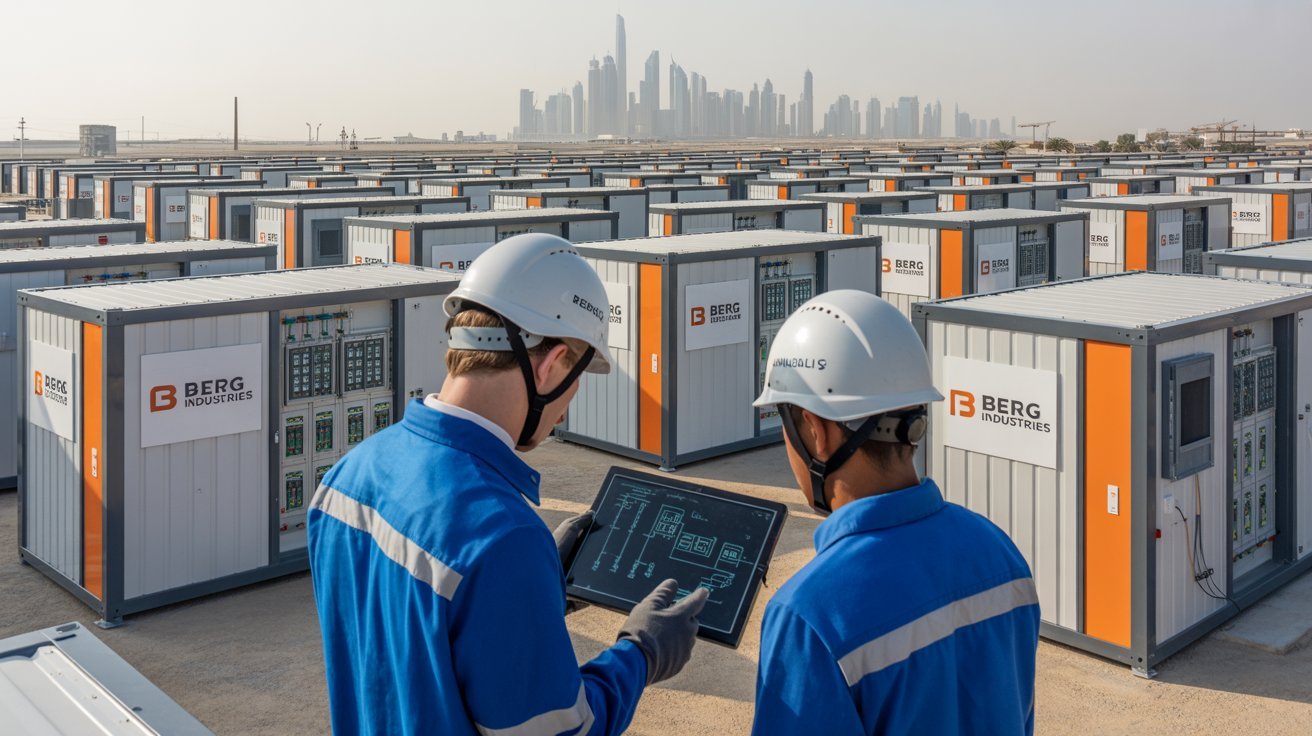
A project manager overseeing a greenfield gas compression facility 160 kilometres from the nearest urban centre faces a set of problems that rarely surface in the project schedule until construction is already underway: how do you build a compliant, fully functional electrical infrastructure in a location with no permanent workforce, extreme ambient temperatures, and zero tolerance for installation delays that ripple into mechanical and instrumentation completion? For EPC leads across the GCC, this scenario describes active projects in 2026. The answer, specified with increasing regularity in ADNOC-aligned and client-driven scopes from Abu Dhabi to the Rub’ al Khali, is the prefabricated electrical house. Working with the right electrical houses manufacturer before procurement closes determines whether that answer holds on site.
Why Remote Site Electrical Infrastructure Is a Different Problem
Remote industrial sites across the UAE and wider GCC impose conditions that site-built electrical rooms cannot reliably accommodate. The challenges are not theoretical, and they are not solved by specifying higher-quality individual components.
Ambient temperatures in inland desert environments regularly exceed 50°C during summer months, placing sustained thermal load on switchgear, relay panels, and cable insulation that was never designed for continuous exposure to those conditions without dedicated environmental conditioning. Coastal and offshore sites add airborne salinity, elevated humidity, and corrosive particulates that accelerate insulation degradation and switchgear contact wear on timescales that are compressed compared to temperate environments. The sites themselves are frequently located in areas without established utility infrastructure, permanent accommodation, or reliable access to the specialist trades, including LV panel wiremen, instrument technicians, and protection relay engineers, that electrical installation work requires.
Compounding these physical realities is a schedule dynamic that creates genuine project risk. On remote sites, parallel trades cannot operate at the density achievable on urban or brownfield refinery projects. Civil works, mechanical installation, and electrical infrastructure compete for the same access windows, the same crane lifts, and the same accommodation capacity. Any slip in one trade propagates directly into the others.
E-House manufacturers UAE address this problem at the root rather than managing its symptoms after they appear on site.
What a Prefabricated Electrical House Actually Is
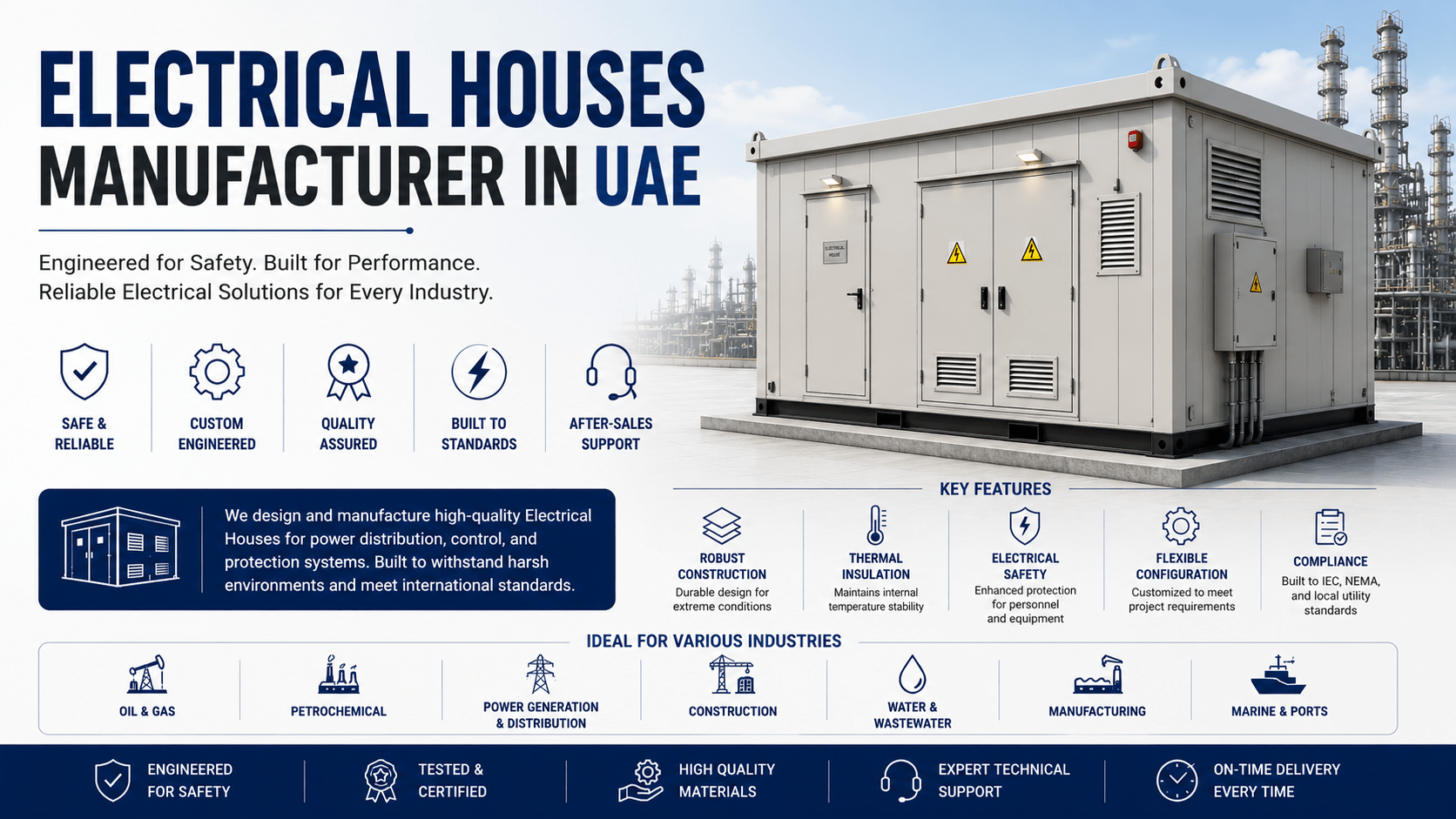
A prefabricated electrical house, abbreviated to E-House across the industry, is a factory-built, self-contained structure that integrates all required electrical systems within a single deployable unit. These systems typically include MV and LV switchgear assemblies, power distribution modules, motor control centres, protection relay panels, UPS systems, emergency lighting, HVAC equipment, and instrumentation interface provisions. The complete assembly is fabricated, internally wired, tested, and pre-commissioned in a controlled workshop environment before transport to site.
This is structurally different from a brick-and-mortar electrical room built in the field, where individual components arrive separately and are integrated by site crews working under constraints that no workshop environment imposes.
Factory Integration vs. Site Construction
In a workshop fabrication model, all sub-assemblies arrive at a controlled facility under one roof. The structural enclosure is fabricated to specified dimensional tolerances. MV and LV switchgear is positioned, anchored, and busbar-connected. Cable management systems are installed and dressed. Power cables are pulled to terminal blocks and labelled. Protection relays are configured and loop-tested using site-equivalent instrument loop drawings. HVAC units are installed and pressure-tested. The complete unit is then function-tested as an integrated system before it leaves the facility.
A site-built equivalent requires each of these activities to be sequenced and coordinated on location, under ambient conditions that are frequently hostile, with craft labour constrained by remote site logistics. The number of interface points between the structural contractor, the electrical subcontractor, the HVAC installer, and the instrumentation team creates coordination overhead that compounds on remote sites where communication and direct supervision are more difficult.
Factory Acceptance Testing Before Mobilisation
The ability to conduct a complete Factory Acceptance Test (FAT) before the unit is shipped to site is one of the most operationally significant advantages of the prefabricated model. A properly scoped FAT for a prefabricated electrical house includes the following verified stages:
- Functional verification of all switchgear operating mechanisms and interlocking logic
- Primary injection testing of protection relay trip circuits and time-current characteristic confirmation
- HVAC performance verification under simulated thermal load
- UPS transfer time measurement and battery autonomy verification
- Megger insulation resistance testing on all cable terminations
- Functional loop tests on all instrumentation interfaces and signal circuits
Problems identified during FAT are resolved in the workshop, where the full complement of technical resources, test equipment, and replacement components is immediately accessible. The same problems identified after site installation require mobilisation of specialist engineers to a remote location, with spare part lead times that can extend into weeks on sites without local supply chains.
Core Benefits of Prefabricated Electrical Houses for Remote Projects
The benefits of specifying a prefabricated E-House over site-built electrical infrastructure are measurable across schedule, quality, safety, and total installed cost. Each benefit is more pronounced on remote sites than on accessible urban or near-shore locations.
The following core benefits apply specifically to remote industrial site deployments and should be evaluated against the particular constraints of the project environment before procurement decisions are finalised.
- Schedule compression through parallel fabrication. The E-House is fabricated in the workshop while civil and mechanical works proceed on site simultaneously. On remote sites where sequential scheduling is frequently imposed by access limitations, this parallel workstream is often the only mechanism available to protect the project’s mechanical completion milestone.
- Reduced dependence on site craft labour. Remote sites in the UAE and GCC face genuine skilled labour availability constraints, particularly for electrical installation. Concentrating the switchgear integration, panel wiring, and relay configuration work at the fabrication facility removes the most skilled-labour-intensive activities from the site critical path.
- Controlled quality environment. Workshop fabrication eliminates the quality variables that site conditions impose: dust contamination during cable pulling, moisture ingress during open-installation phases, interruptions from concurrent site activities. Protection relay settings configured in a controlled environment with stable power and calibrated test equipment carry a lower error probability than field commissioning under operational constraints.
- Single-lift site installation. A completed prefabricated electrical house arrives at site as a single unit, ready for final connections to incoming power, outgoing field cables, and instrument interface circuits. The site electrical installation scope is compressed to foundation bolting, incoming cable termination, and field interface connections.
- Certification and documentation integrity. A certified switchgear enclosure manufacturer UAE designs and tests the complete assembly as a certified system. Third-party inspection agency witnessing of the FAT is achievable in a controlled workshop environment in a way that is not practically replicable on a distributed site build, which is directly relevant for ADNOC-governed projects or those with independent lender engineer requirements.
E-House Configuration Options for Remote Industrial Sites
Prefabricated electrical houses are not a standardised product. Configuration varies significantly based on voltage class, environmental classification, power demand, hazardous area zone, and site-specific transport constraints. Understanding the configuration variables allows procurement teams to build specifications that reflect actual project requirements rather than generic industry templates.
The table below outlines the primary configuration dimensions for E-Houses used on remote industrial sites and the key engineering decisions associated with each.
| Configuration Dimension | Available Options | Key Consideration for Remote Sites |
| Voltage class | LV (400V), MV (6.6kV or 11kV), combined MV/LV | MV switchgear required for larger generation or substation applications |
| Enclosure structure | Steel frame with composite cladding, insulated sandwich panel, reinforced steel | Insulated sandwich panels essential for high-ambient desert environments |
| Enclosure IP rating | IP54, IP55, IP65, IP66 | IP65 minimum for dusty desert sites; IP66 for coastal or offshore installations |
| HVAC configuration | Precision close-control units, split-system AC, or pressurisation with air conditioning | Pressurisation required for Zone 2 hazardous area classification per IEC 60079 |
| Hazardous area classification | Safe area, Zone 2 (ATEX/IECEx), Zone 1 | Zone 2 units require Ex e certified pressurisation and Ex-rated panel components |
| Structural configuration | Single module, or linked multi-module configuration | Multi-module designs used where single-lift transport weight or road envelope is a constraint |
| Internal integration scope | Switchgear only, or full integration with MCC, UPS, relay panels, instrumentation | Fully integrated units reduce site interface complexity and commissioning scope |
MV/LV Switchgear and Power Distribution Modules
The switchgear specification is the technical core of any E-House. For remote site applications, the switchgear selection must account for the extended maintenance intervals that characterise remote operations. At MV level, vacuum circuit breakers (VCBs) are preferred over older air-blast or minimum oil types because they require less maintenance and carry a lower probability of in-service failure between scheduled outage windows.
Power distribution modules within the E-House are sized and configured around the project’s specific load schedule. For remote oil and gas facilities, typical loads include motor starters for pumps and compressors, UPS-backed control power for DCS and protection systems, lighting and small power distribution, heat tracing circuits, and instrument power rails. The internal panel layout must maintain physical separation between instrument power circuits and motor starting circuits to prevent interference on sensitive 4-20mA and discrete signal loops.
HVAC Design and Environmental Zoning for Remote Sites
The HVAC system in a remote site E-House carries a different design brief than a commercial air conditioning installation. Its primary function is to maintain switchgear and relay equipment operating temperatures within OEM-specified limits under the sustained ambient conditions of the installation site. For GCC desert locations, this means maintaining internal temperatures below 40°C when external ambient conditions reach 50°C or above, with solar radiation loading on roof and south-facing panel surfaces adding heat gain beyond ambient air temperature alone.
Effective HVAC design for a remote site E-House manufacturers UAE application includes these design principles:
- N+1 cooling unit redundancy so a single unit failure does not trigger a unit shutdown or forced de-energisation
- Ducted air distribution that reaches switchgear bottom sections, where heat accumulation from internal losses is highest
- A positively pressurised internal environment for units installed in or adjacent to Zone 2 hazardous areas, in compliance with IEC 60079-13
- High-efficiency particulate inlet filtration for coastal installations, rated to handle salt-laden air without HVAC coil corrosion over the design service life
For generator enclosures manufacturers UAE providing acoustic or weatherproof enclosures on the same site as the E-House, HVAC inlet and exhaust zoning must be coordinated to avoid generator exhaust recirculation into the E-House HVAC intake. This coordination is simpler when the generator enclosure and E-House are designed by the same fabricator.
What to Evaluate When Selecting an Electrical Houses Manufacturer in the UAE
Procurement engineers shortlisting E-House manufacturers UAE for a remote site project should evaluate suppliers against criteria that are directly relevant to the quality and long-term reliability of the delivered unit, not only on price and headline delivery schedule. In 2026, with capital expenditure in the UAE’s oil and gas and infrastructure sectors maintaining high levels, fabrication capacity among qualified manufacturers is constrained. Early supplier qualification and vendor engagement is a risk mitigation action, not a procurement formality.
The following evaluation criteria are structured around the specific demands of remote site E-House supply:
Workshop certification and test equipment capability. Verify that the manufacturer holds a current ISO 9001 certification covering the full scope of design, fabrication, and testing. Confirm that the workshop is equipped with the test equipment required to conduct a meaningful FAT: primary injection test sets for protection relay characterisation, calibrated meggers for insulation resistance testing, and power analysers for load verification. An FAT conducted without the correct test equipment is a documentation exercise rather than a functional verification.
Experience at the specified voltage class and environmental rating. An electrical houses manufacturer with a strong track record in LV distribution panel assembly may not have the engineered switchgear integration experience required for an 11kV MV E-House. Request references for completed projects at the voltage class, IP rating, and hazardous area classification applicable to your requirement.
In-house HVAC engineering capability. Manufacturers who subcontract HVAC design and installation introduce an interface point between structural, electrical, and mechanical design that may not be coordinated from the outset. In-house HVAC capability ensures thermal modelling is integrated with electrical layout during the design phase, not retrofitted after panel positions are fixed.
Structural and transportation engineering scope. Remote site E-Houses are frequently transported on flatbed trailers over unpaved access roads and temporary haul routes, exposing the structure to dynamic loading conditions that a static operational structural design does not address. Confirm that the manufacturer includes transportation analysis and lifting lug design in their engineering scope, with documentation to support the site installation method statement.
Quality plan with defined inspection hold points. Projects with ADNOC, client, or independent lender requirements for third-party inspection need a manufacturer whose Inspection and Test Plan (ITP) includes defined hold and witness points at which the client and inspection agency are formally notified. Confirm this before contract award, not at the start of fabrication.
Berg Engineering’s E-House Capabilities for GCC Remote Projects
Berg Engineering designs and manufactures prefabricated electrical houses from fabrication facilities in Ras Al Khaimah and Sharjah. The manufacturing scope covers structural enclosure fabrication in carbon steel and stainless steel configurations, internal panel and switchgear integration, HVAC system installation and commissioning, full cable management installation, and pre-shipment Factory Acceptance Testing for LV and MV voltage class E-Houses.
Berg holds ASME, ISO 9001, and UL certifications, and the quality management systems required to support third-party witnessed FATs are embedded within the production workflow. For procurement engineers working against ADNOC-approved vendor lists or projects with independent engineer hold point requirements, this certification baseline is a procurement prerequisite.
As a switchgear enclosure manufacturer UAE, Berg integrates switchgear from client-nominated OEM vendors into the E-House structure, coordinating vendor installation requirements and FAT participation within the fabrication schedule. This reduces the number of parallel contractor interfaces the client must manage during fabrication.
Berg’s fabrication scope also covers modular substations for remote infrastructure projects, where the transformer enclosure, MV switchgear room, LV distribution room, and auxiliary systems are designed as a coordinated modular layout. For projects requiring control room buildings alongside the E-House, Berg fabricates the structural module and integrates internal fit-out, including cable trays, instrument racks, and HVAC, as a complete prefabricated unit.
For further context on Berg’s modular fabrication capabilities and how they apply to integrated remote site power and process infrastructure, see modular fabrication UAE and the Berg Engineering services overview.
Frequently Asked Questions
What certifications should an electrical houses manufacturer in the UAE hold for oil and gas projects?
An electrical houses manufacturer supplying to oil and gas projects in the UAE should hold ISO 9001 covering design and manufacturing, with quality systems capable of supporting third-party witnessed inspections at defined hold points. For projects under ADNOC jurisdiction, ASME certification and UL compliance may be specified depending on the equipment integrated within the unit. For E-Houses installed in hazardous areas, IECEx certification of the pressurisation system and internal Ex-rated components is a technical requirement under IEC 60079.
What IP rating is required for an E-House installed on a UAE desert site?
For a UAE desert site with exposure to airborne sand and dust, the minimum enclosure IP rating is IP65 per IEC 60529, which certifies complete dust ingress protection and resistance to low-pressure water jets from any direction. For coastal sites within approximately 5 kilometres of the sea, IP66 is standard practice to provide protection against high-pressure water jet exposure. Hazardous area E-Houses in Zone 2 classifications require a certified Ex e pressurisation system under IEC 60079-13, which addresses flammable gas ingress separately from the IP rating.
What is a realistic fabrication lead time for a prefabricated E-House from a UAE manufacturer?
Lead time for a prefabricated electrical house from a UAE-based electrical houses manufacturer is driven primarily by switchgear procurement from the OEM vendor. A standard LV E-House with pre-specified and expedited switchgear typically runs 14 to 20 weeks from purchase order to FAT completion. MV E-Houses, hazardous area certified units, or those with complex multi-module configurations may require 24 to 32 weeks. Early MV switchgear purchase order placement, independent of the E-House fabrication order if necessary, is the most effective schedule risk mitigation available to procurement teams.
Can a prefabricated E-House be certified for installation in a Zone 2 hazardous area on a gas processing site?
Yes. Prefabricated E-Houses are designed and certified for Zone 2 installation through Ex e pressurisation systems that maintain positive internal pressure relative to the external atmosphere, preventing the ingress of flammable gases under normal operating conditions. The pressurisation system and all Ex-rated internal components must be certified to IEC 60079 by a recognised certification body. The site hazardous area classification drawing must be issued before E-House engineering begins, as the zone boundary directly governs the equipment selection and certification requirement.
What is the difference between modular substations and a standard prefabricated E-House?
Modular substations are complete power transformation and distribution systems built in prefabricated sections, typically combining a transformer section, an MV switchgear room, and an LV distribution room in a coordinated multi-module layout. A prefabricated electrical house typically refers to a single module containing distribution and control equipment at LV or MV level, without an integrated power transformer. In practice, the boundary between the two terms overlaps on projects where the E-House includes MV switchgear and transformer interface provisions, and the distinction is best resolved by defining the exact voltage class, transformation scope, and module count in the project specification before vendor enquiry.