A pipeline project in the Eastern Province of Saudi Arabia stalls at mechanical completion because three process skids, each fabricated by a different vendor to different dimensional and documentation standards, arrive on site with incompatible flange connections, mismatched instrument signal conventions, and no unified pre-commissioning test record. The schedule impact is measured in weeks. The cost impact, once specialist engineers are mobilised to site for field rework, is multiples of what a coordinated modular engineering solutions approach would have cost at procurement. This scenario is not exceptional. It describes a class of project execution problems that EPC leads across the GCC encounter regularly on fast-tracked capital projects, and it is the precise category of risk that structured technical & modular solutions are designed to eliminate before the equipment leaves the fabrication facility.
The Industrial Case for Modular Project Delivery
The shift toward modular delivery across the GCC’s oil and gas, power generation, water treatment, and infrastructure sectors reflects a set of project execution constraints that conventional site-build methodology has not reliably resolved. Understanding what is driving that shift requires looking at specific project conditions, not at high-level commentary about construction trends.
Remote site access remains the most consistent driver. Infrastructure projects in the UAE’s inland desert regions, offshore gas fields in the Arabian Gulf, and remote water injection facilities across Oman and Saudi Arabia share a common constraint: the trades, materials, and supervision required to build complex process systems in the field must be mobilised to locations where productivity is lower, quality control is harder, and schedule recovery options are limited. The economic case for removing as much of that complexity as possible from the site construction phase, and concentrating it in a controlled fabrication environment, is straightforward.
Workforce availability adds a second dimension. GCC construction and fabrication markets in 2026 are characterised by strong project pipelines across multiple sectors simultaneously, creating measurable competition for experienced welders, pipefitters, instrument technicians, and commissioning engineers. A skid package manufacturer in UAE operating a permanent, skilled fabrication workforce offers a qualitatively different execution environment than a site labour force assembled for a single project under remote site conditions.
Third is the increasingly common requirement for integrated pre-commissioning and Factory Acceptance Testing (FAT) before site mobilisation. Clients, EPCs, and independent lenders on capital projects have progressively tightened their quality documentation requirements. A packaged system and skid that arrives at site with a complete FAT record, including functional test results, instrument calibration certificates, and pressure test documentation, provides a risk profile that no site-built equivalent can match.
These three conditions, taken together, explain why modular engineering solutions have become the default specification on a growing proportion of GCC industrial infrastructure projects, rather than an alternative considered only for exceptional circumstances.
Defining the Scope of Technical and Modular Solutions
Technical & modular solutions is not a single product category. It is a delivery methodology applied across a range of process and utility systems, each with different engineering content, different fabrication complexity, and different site interface requirements. Before a procurement team can specify or evaluate a modular solution, the scope boundaries must be defined with precision.
At the most fundamental level, a modular solution concentrates multi-discipline engineering, including civil or structural design, mechanical process design, piping and valve assembly, electrical installation, instrumentation, and control integration, into a single fabricated unit. That unit is designed, built, tested, and documented as an integrated system in the manufacturer’s workshop. The site installation scope is reduced to foundations, interconnecting pipework or cable connections, and final commissioning activities that require live process conditions to complete.
The specific form that a modular solution takes is determined by the process function it performs.
Skid-Mounted Process and Utility Packages
A skid-mounted package is a process or utility system assembled on a structural steel baseframe, designed for single-lift installation and direct connection to the plant piping and electrical systems on site. The baseframe defines the module boundary. Everything within it, including pressure vessels, heat exchangers, pumps, valves, instrument transmitters, junction boxes, and local control panels, is a fabricator responsibility rather than a site construction responsibility.
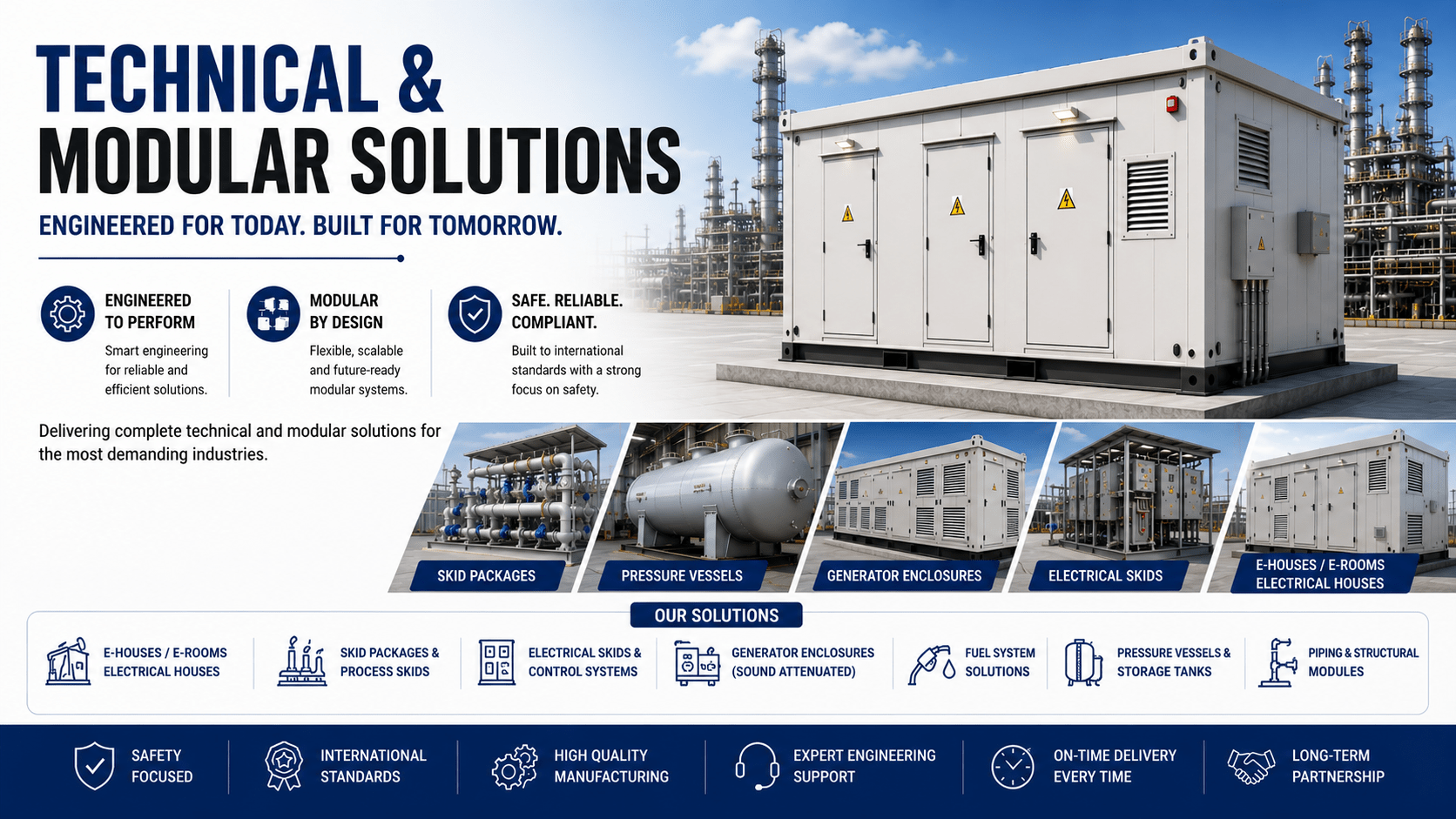
Common skid-mounted packages in GCC oil and gas and infrastructure applications include chemical injection skids, produced water treatment packages, gas conditioning units, fuel gas conditioning skids, metering skids, pig launcher and receiver packages, chemical dosing systems for water treatment plants, and utility systems including compressed air, nitrogen generation, and diesel fuel supply. Each of these represents a defined process function that can be fully engineered, fabricated, and tested as a self-contained unit.
Modular Technical Buildings and E-Houses
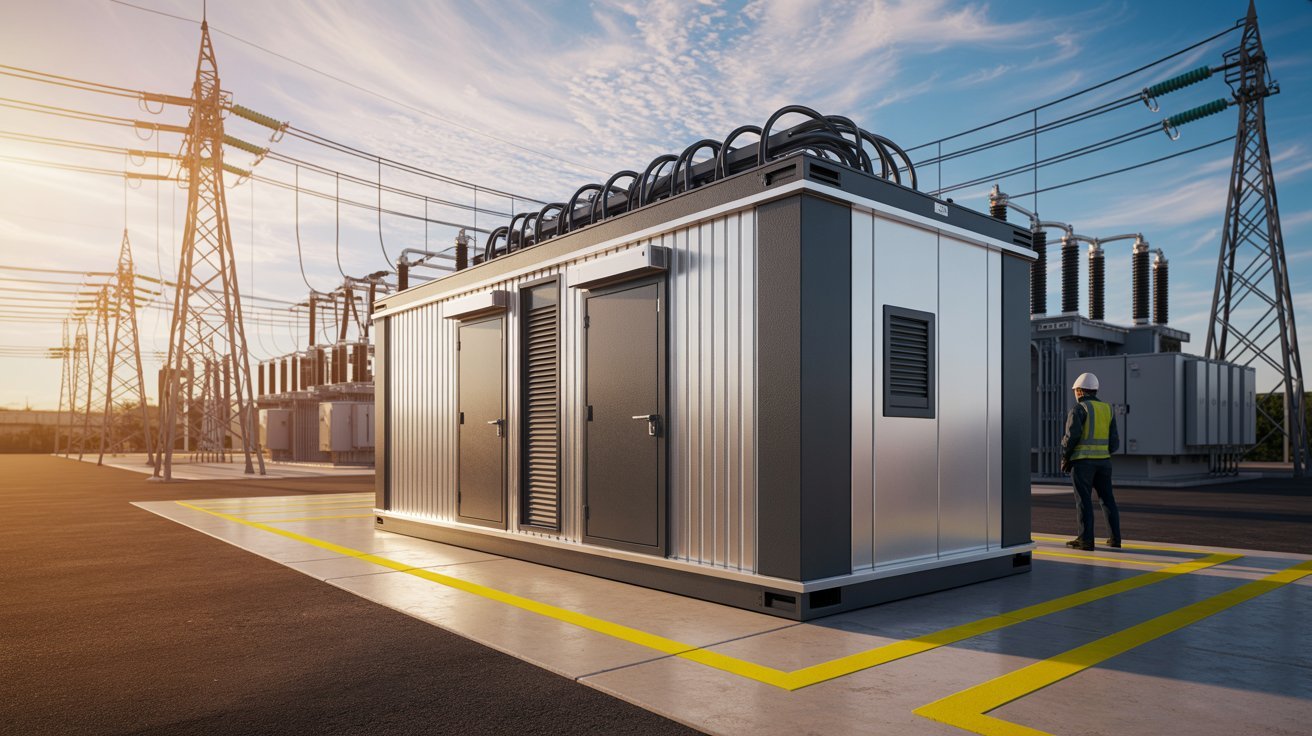
Modular technical buildings (E-House) extend the modular delivery principle to built infrastructure rather than process systems. A prefabricated electrical house integrates switchgear, motor control centres, protection relay panels, UPS systems, HVAC, and cable management into a factory-built structural enclosure. The unit is a building and an electrical system simultaneously, designed, fabricated, and FAT-tested as a single coordinated assembly.
Modular technical buildings used in industrial applications are not limited to electrical functions. Prefabricated control rooms, telecommunications buildings, instrument equipment rooms, and operator shelter buildings follow the same delivery model: factory fabrication of the complete structure and internal fit-out, FAT of installed systems, and single-lift site installation with field connections only. On remote sites, the ability to deliver a fully conditioned, tested, and operational technical building by crane set is a schedule and quality advantage that site-built equivalents cannot replicate.
Skid Package Fabrication: Engineering Depth and Execution Standards
The quality of a packaged system and skid is determined primarily by the engineering depth applied during the design phase and the fabrication standards maintained during production. For procurement engineers evaluating skid package manufacturer in UAE options, understanding what constitutes rigorous engineering and fabrication practice is the foundation of a meaningful vendor assessment.
Design integration across disciplines is the first critical variable. A process skid that is designed by a process engineer without active coordination with the structural, piping, electrical, and instrumentation disciplines will generate field modification requests during fabrication when dimensional conflicts, access constraints, and instrument location problems emerge. These conflicts are resolved cheaply in a 3D model or piping isometric review. They are resolved expensively in a workshop during fabrication, and even more expensively in the field after installation.
The following piping and instrumentation design standards apply to prefabricated industrial systems produced for the UAE and GCC oil and gas sector:
- Piping materials and specifications must be aligned with the project piping class document. For oil and gas service, carbon steel (CS) is standard for non-corrosive hydrocarbon service; 316L stainless steel (SS) for chemical injection and corrosive service; duplex stainless steel (DSS) for high-chloride or sour service where H2S partial pressure exceeds NACE MR0175 thresholds
- All pressure piping fabricated in skid packages for hydrocarbon or high-pressure service must be fabricated and tested to ASME B31.3, including weld documentation, hydrostatic or pneumatic test records, and radiographic or ultrasonic inspection where specified
- Instrumentation installation must follow ISA 5.1 for tag numbering conventions and the project instrument installation specifications for root valve, manifold, and impulse line configuration
- Electrical installation within the skid must be consistent with the area classification drawing for the installation location, with appropriate cable gland and junction box ratings for the specified zone
Fabrication quality is maintained through a documented Inspection and Test Plan (ITP) that defines hold points, witness points, and review points for each critical fabrication activity. For projects with ADNOC oversight, client inspection representative requirements, or independent lender engineer involvement, the ITP must be submitted and approved before fabrication begins, not retroactively completed after the work is done.
Pre-Commissioning and Factory Acceptance Testing for Skid Packages
The FAT is the primary mechanism through which the fabricator demonstrates that the packaged system and skid functions as designed before it leaves the workshop. A rigorous FAT for a process skid includes the following activities:
- Visual and dimensional inspection against the approved general arrangement drawing and 3D model
- Instrument loop testing for all 4-20mA signals, discrete inputs and outputs, and communications interfaces, using calibrated test equipment and simulation where live process fluids cannot be used in the workshop
- Functional testing of all control and shutdown logic, including ESD trip testing where a control system is integrated within the skid
- Hydrostatic pressure testing of all pressure-containing piping and vessels to the specified test pressure, with documented hold times and acceptance criteria
- Electrical insulation resistance testing on all installed cabling
- Verification of all safety relief valve settings against the process safety documentation
- Completeness check against the material take-off and packing list before shipment
FAT completion records, including signed test certificates, loop test sheets, and punch list close-out documentation, should form part of the handover documentation package to the client. This documentation set is the warranty baseline and the commissioning reference document for site teams.
Comparison: Modular Fabrication vs. Conventional Site Construction
The decision between a turnkey modular solutions delivery model and conventional site construction is a project execution decision with direct financial and schedule consequences. It is not a preference or a philosophical position. The comparison must be evaluated against the specific conditions of the project, including site location, project schedule, quality requirements, and the trade skills available in the project’s geographic market.
The table below sets out the key performance dimensions of each delivery model for a representative remote industrial infrastructure project in the UAE or GCC.
| Evaluation Dimension | Turnkey Modular Solutions | Conventional Site Construction |
| Quality control environment | Controlled workshop conditions with fixed test equipment | Variable field conditions, quality dependent on site crew performance |
| Pre-shipment testing capability | Full FAT achievable before site mobilisation | Site commissioning is the first integrated test of the system |
| Schedule impact of remote access | Parallel fabrication while civil works proceed on site | Sequential or compressed parallel execution with site access constraints |
| Dependence on site craft labour | Skilled work concentrated in fabrication facility | Full skilled trade complement required on site for full installation duration |
| Multi-vendor interface complexity | Single fabricator accountable for integrated unit | Multiple subcontractors with separate scopes and coordination requirements |
| Documentation completeness | Complete as-built and test documentation produced at FAT | Documentation assembled from multiple site contractors post-installation |
| Third-party inspection access | Inspection concentrated at fabrication facility | Inspection distributed across site activities and schedule |
| Transport and logistics | Single-lift delivery required; transport engineering needed | No transport requirement; materials delivered individually |
| Suitability for hazardous area certification | Certification of complete unit achievable in workshop | Certification of individual components; integration certification requires field verification |
| Modification and future expansion | Workshop-fabricated connections designed for module addition | Field modification required for any future scope addition |
The transport and logistics dimension deserves specific attention for remote GCC projects. A skid package manufacturer in UAE with transportation engineering capability will include road transport analysis, trailer selection, route survey, and lifting lug design in the engineering scope. This is not a standard inclusion across all fabricators. Confirm during vendor qualification that transportation engineering is part of the contract scope, particularly for heavy or oversized units that require special transport permits on UAE federal or emirate road networks.
Modular Technical Buildings and Control Room Buildings for Industrial Sites
Modular technical buildings serve a broader function on industrial sites than electrical power distribution alone. The same prefabrication principles that apply to E-Houses extend to control room buildings, telecommunications equipment rooms, analyser shelters, laboratory buildings, operator shelters, and combined MCC and instrument rooms.
For a remote gas processing facility, the full technical building scope might include a prefabricated control room building housing the DCS operator workstations, engineering terminals, and communication equipment, a separate prefabricated MCC room housing motor control centres and local instrument junction panels, an analyser shelter housing online gas chromatographs and H2S analysers calibrated to the process stream composition, and a welfare and administration building for site operators. Each of these buildings, designed as modular prefabricated units, can be fabricated simultaneously in the same facility, coordinated to the same structural grid and interconnecting cable route layout, and delivered to site in a single transport convoy for concurrent installation.
The design coordination advantage of using a single skid package manufacturer in UAE for both the process skids and the technical buildings is significant. Instrument cable schedules, electrical load lists, HVAC sizing, and structural interface details that must be aligned between the process equipment and the technical buildings are coordinated within a single engineering team rather than between multiple contractors working independently. This reduces the number of interface queries, RFIs, and coordination meetings that consume project management time during fabrication.
For projects classifying any part of the technical building area as Zone 2 under IEC 60079, the modular building manufacturer must design and certify the pressurisation system and all Ex-rated penetrations as part of the structural building package. This certification scope is defined in the project hazardous area classification drawing and must be agreed with the manufacturer at contract stage.
What a Rigorous Modular Engineering Partner Actually Delivers
Modular engineering solutions delivered at the standard that GCC oil and gas and infrastructure projects require in 2026 are not a catalogue of standard products selected from a range. They are engineered systems developed against project-specific process data sheets, equipment lists, piping and instrumentation diagrams, area classification drawings, and electrical load lists. The distinction between a fabricator who builds to a provided design and an engineering-led turnkey modular solutions partner who develops the design and takes responsibility for its technical integrity has direct implications for the project team’s workload and for the quality of the delivered unit.
An engineering-led modular partner contributes the following scope that a build-only fabricator does not:
- Preparation and issue of detailed design documentation, including general arrangement drawings, piping isometrics, instrument datasheets, electrical schematics, and 3D model, for client and third-party review before fabrication begins
- Participation in HAZOP and HAZID reviews where the modular package is within the review boundary, with formal close-out of action items through the design documentation
- Development and submission of the ITP for client and inspection agency approval
- Management of vendor documentation from switchgear, instrument, and valve OEMs, including compliance with the project vendor document requirement list
- Coordination of third-party inspection agency witness activities within the fabrication schedule
- Preparation of the complete mechanical completion and handover dossier, including as-built drawings, material certifications, weld records, pressure test records, instrument calibration certificates, and FAT test records
For procurement engineers building the inquiry package for a modular solutions contract, specifying this engineering scope explicitly in the scope of work is the most effective way to ensure that vendor bids are comparable and that the winning contractor’s obligations are contractually defined from the outset.
The following checklist items should be confirmed during vendor technical evaluation for a prefabricated industrial systems contract:
- Does the vendor hold ISO 9001 certification covering design, fabrication, and testing?
- Does the vendor’s engineering team include discipline leads for process, structural, piping, electrical, and instrumentation design, or is any discipline subcontracted?
- What 3D modelling platform does the vendor use, and can model clash detection reports be issued to the client during detailed design?
- What FAT facility and test equipment does the vendor maintain on-site at the fabrication facility?
- Can the vendor provide references for completed modular packages in the same voltage class, process service, or hazardous area classification as the project requirement?
- Does the vendor include transportation engineering and lifting analysis in their standard scope?
Berg Engineering’s Modular and Technical Solutions Capabilities
Berg Engineering designs and fabricates technical & modular solutions for oil and gas, power generation, water treatment, and infrastructure projects from facilities in Ras Al Khaimah and Sharjah. The fabrication scope covers skid-mounted process and utility packages, chemical injection skids, oil coalescer skid packages, prefabricated electrical houses, modular technical buildings (E-House), modular substations, control room buildings, and structural steel assemblies.
As an established skid package manufacturer in UAE, Berg’s engineering team manages multi-discipline design in-house, including process and mechanical, piping, structural, electrical, and instrumentation disciplines. This in-house integration eliminates the subcontractor interface gaps that characterise fabricators who outsource discipline design work. The complete engineering and fabrication workflow operates within Berg’s ISO 9001 certified quality management system, with ITPs structured to accommodate third-party inspection witness requirements from ADNOC-approved inspection agencies.
Berg’s ASME U Stamp and NB certification supports the fabrication of pressure vessels integrated within skid packages, eliminating the need for a separate pressure vessel subcontractor on projects where the process skid includes coded pressure equipment. ASME B31.3 process piping fabrication is executed within the same facility, with weld documentation and NDE managed under the Berg quality programme.
For prefabricated industrial systems delivered to remote UAE and GCC sites, Berg’s scope includes transportation engineering support for oversized or heavy lifts, with coordination of special transport permits and lifting analysis documentation for site installation planning.
For further detail on Berg’s chemical injection and process skid capabilities, see chemical injection skid packages. For E-House and modular building fabrication scope, see modular technical buildings and E-House solutions.
Frequently Asked Questions
What engineering certifications should a skid package manufacturer in UAE hold for oil and gas projects?
A skid package manufacturer in UAE supplying to oil and gas projects should hold ISO 9001 certification covering design, fabrication, and testing. For packages containing pressure vessels fabricated to ASME Section VIII Division 1, ASME U Stamp certification is required. For process piping within the skid in hydrocarbon service, ASME B31.3 compliance must be documented through weld records, material certificates, and pressure test records. For packages installed in hazardous areas, IECEx or ATEX certification of Ex-rated components and the associated area classification documentation must be provided.
What does a Factory Acceptance Test for a modular engineering solution typically include?
A FAT for a modular engineering solutions package includes dimensional and visual inspection against approved drawings, instrument loop testing of all signal circuits with calibrated test equipment, functional testing of control and ESD logic, hydrostatic or pneumatic pressure testing of all pressure-containing piping, insulation resistance testing on all cabling, and verification of safety relief valve set pressures. The FAT record, including signed test sheets and punch list close-out documentation, forms part of the mechanical completion handover package and serves as the commissioning baseline document for the site team.
How does the modular delivery model reduce schedule risk on remote GCC industrial projects?
Turnkey modular solutions reduce schedule risk by enabling parallel execution of workshop fabrication and site civil and foundation works. On remote sites where sequential scheduling is imposed by access, accommodation, and trade availability constraints, this parallelism is often the only available mechanism to protect the mechanical completion milestone. Additionally, the concentration of multi-discipline skilled work in the fabrication workshop removes the most schedule-sensitive activities from the site critical path, where productivity is lower and recovery options are more constrained.
Can prefabricated industrial systems be designed for installation in Zone 2 hazardous areas?
Yes. Prefabricated industrial systems, including skid packages and modular technical buildings (E-House), can be designed and certified for Zone 2 installation under IEC 60079. Skid packages in Zone 2 locations require Ex-rated electrical components, including junction boxes, local control panels, and instrument housings, certified to appropriate protection concepts such as Ex e, Ex d, or Ex ia as determined by the area classification and equipment function. E-Houses and modular buildings in Zone 2 require Ex e pressurisation systems certified under IEC 60079-13. The hazardous area classification drawing must be issued to the fabricator at the start of the design phase, as zone boundaries govern all equipment selection decisions within the module.
What is the advantage of using a single supplier for both skid packages and modular technical buildings on the same project?
Using a single skid package manufacturer in UAE for both process skids and modular technical buildings on the same project ensures that instrument cable schedules, electrical load lists, HVAC thermal modelling, and structural interface details are coordinated within a single engineering team. This reduces the interface queries, field RFIs, and cross-contractor coordination that arise when the process skid fabricator and the building fabricator work independently. It also simplifies inspection management, documentation control, and schedule coordination during fabrication, with a single ITP, single FAT programme, and single handover documentation package for the complete modular scope.