A UAE refinery project manager identified the problem during a mechanical completion review in early 2026. The shell-and-tube heat exchangers on site had been fabricated to TEMA Class C tolerances. The project datasheet had specified Class R. The heat exchanger manufacturer in question had met the delivery date and stayed within budget. What arrived was thermal equipment that required retubing within fourteen months of first operation, at a cost that exceeded the original purchase order.
The selection criteria that produced that outcome were not unreasonable on paper: competitive pricing, an acceptable lead time, a reference list with recognisable project names. What the evaluation failed to verify was fabrication class compliance, weld procedure qualification records, and whether the thermal design had been validated against the actual process conditions before fabrication drawings were released.
Choosing the right heat exchanger manufacturer for a GCC industrial project is a decision with consequences that rarely surface at delivery. They appear at the first statutory inspection, in performance shortfalls traced back to inadequate design margins, or in corrosion findings that reflect material selection unsuited to the operating environment. Industrial heat exchangers cover a broad range of configurations including shell-and-tube, plate, air-cooled, and double-pipe designs. Shell-and-tube remains the dominant heat exchanger type in oil and gas and power generation service across the GCC, and the evaluation principles below apply across heat exchanger types wherever pressure code compliance, material certification, and fabrication quality are the primary procurement criteria. This guide covers ten specific factors that procurement engineers and EPC leads should verify before committing to any heat exchanger companies on a GCC project. Each reflects a documented category of failure in the UAE and regional market.
What Certifications a Heat Exchanger Manufacturer Must Hold
Certifications define the outer boundary of what a manufacturer is legally and technically qualified to fabricate. They are not a general proxy for quality, but a confirmation that specific design, fabrication, inspection, and documentation processes have been audited against a defined standard. For industrial heat exchangers in oil and gas, power generation, and water treatment, the relevant codes carry precise scope boundaries that cannot be substituted with generic manufacturing credentials.
For pressure-bearing heat exchangers, ASME Section VIII Division 1 is the applicable code for the majority of process service applications across the GCC. Division 2 applies at higher design pressures where alternative design rules and tighter fabrication controls are required. A manufacturer holding an ASME U Stamp has been audited by an Authorised Inspection Agency (AIA) confirming that their design, fabrication, inspection, and documentation processes satisfy ASME requirements. In the UAE, U Stamp certification is a routine procurement prerequisite for process heat exchangers in hydrocarbon service. Verify the certificate directly: confirm its current validity, the issuing AIA, and that the stated scope explicitly covers the heat exchanger type being procured. A U Stamp for unfired pressure vessels does not automatically extend to all heat exchanger configurations.
ISO 9001 quality management certification is a baseline requirement alongside ASME compliance. Verify that the ISO scope statement covers heat exchanger fabrication specifically, not a broad manufacturing description that the stamped document would not genuinely apply to.
TEMA Class and Its Consequences for Service Life
The Tubular Exchanger Manufacturers Association (TEMA) defines three fabrication classes with distinct mechanical consequences: Class R for petroleum and heavy chemical process service, Class B for chemical process applications, and Class C for moderate commercial use. The differences between R and C are not cosmetic. They govern baffle thickness minimums, tube sheet drilling tolerances, shell roundness criteria, and corrosion allowance calculations. A heat exchanger fabricated to TEMA Class C in a service environment that specifies Class R will show accelerated degradation: tube-to-baffle fretting under thermal cycling, reduced service life under sustained operating pressure, and shorter cleaning intervals.
Request the manufacturer’s weld procedure specifications (WPS) and procedure qualification records (PQR) before contract award. Confirm that these documents reference the TEMA class stated in the project datasheet. A manufacturer unable to provide WPS/PQR documentation aligned to the specified class cannot demonstrate code-compliant fabrication capability for that scope.
Engineering Design Capability and Material Competency
A manufacturer that fabricates client-supplied datasheets serves a legitimate function. A manufacturer that produces validated thermal and mechanical designs from a process duty specification is a different type of supplier, and the distinction matters when thermal duties are complex, service conditions fall outside standard configurations, or the project does not have a licensed engineering contractor producing the equipment datasheet independently.
For thermal design, HTRI Xchanger Suite is the recognised industry tool for shell-and-tube exchanger rating and simulation. Manufacturers with in-house thermal design capability can provide a rated datasheet at the quotation stage, showing calculated heat duty against the required process performance, fouling resistances assumed, and the design margin applied. If the manufacturer fabricates a client-supplied datasheet, confirm that the datasheet has been produced and validated by a licensed engineering contractor or the process licensor before fabrication drawings are released. This is a documentation verification step that should occur before order placement, not after.
Material competency is an equally important evaluation. Process heat exchangers across UAE oil and gas, power generation, and water treatment projects are specified across a wide material range depending on fluid chemistry, operating temperature, and corrosion environment. Carbon steel (CS) covers moderate-temperature, low-corrosion duties. Stainless steel grades 304 and 316L handle aqueous and mildly corrosive service. Duplex stainless steel (DSS) and super duplex grades including SAF 2507 are specified for high-chloride environments and produced water duties. Copper Nickel (CuNi 90/10) is the standard for seawater-cooled tube bundles in marine and coastal process applications. Nickel alloys including Inconel 625 and Hastelloy C-276, along with titanium grade 2, apply to acid and high-temperature chemical service.
A manufacturer whose WPS and PQR records cover only CS and standard stainless steel grades is limited in scope for many GCC project specifications. Request material qualification records for each material type listed in the project datasheet. Mill test reports (MTRs) traceable to heat and lot numbers for all pressure-retaining components should be confirmed as a standard documentation deliverable before contracts are placed. As a UAE-based static equipment fabrication in the UAE partner, Berg Engineering holds material qualifications and fabrication records across the full material range specified above for GCC oil and gas and process industry projects.
Fabrication Shop Standards and Physical Capacity
Certifications and engineering qualifications describe what a manufacturer is authorised to design. Shop infrastructure determines what can be physically built to the tolerances and test pressures the applicable code requires. These are separate evaluations, and a documentation review alone does not replace a genuine assessment of fabrication capability.
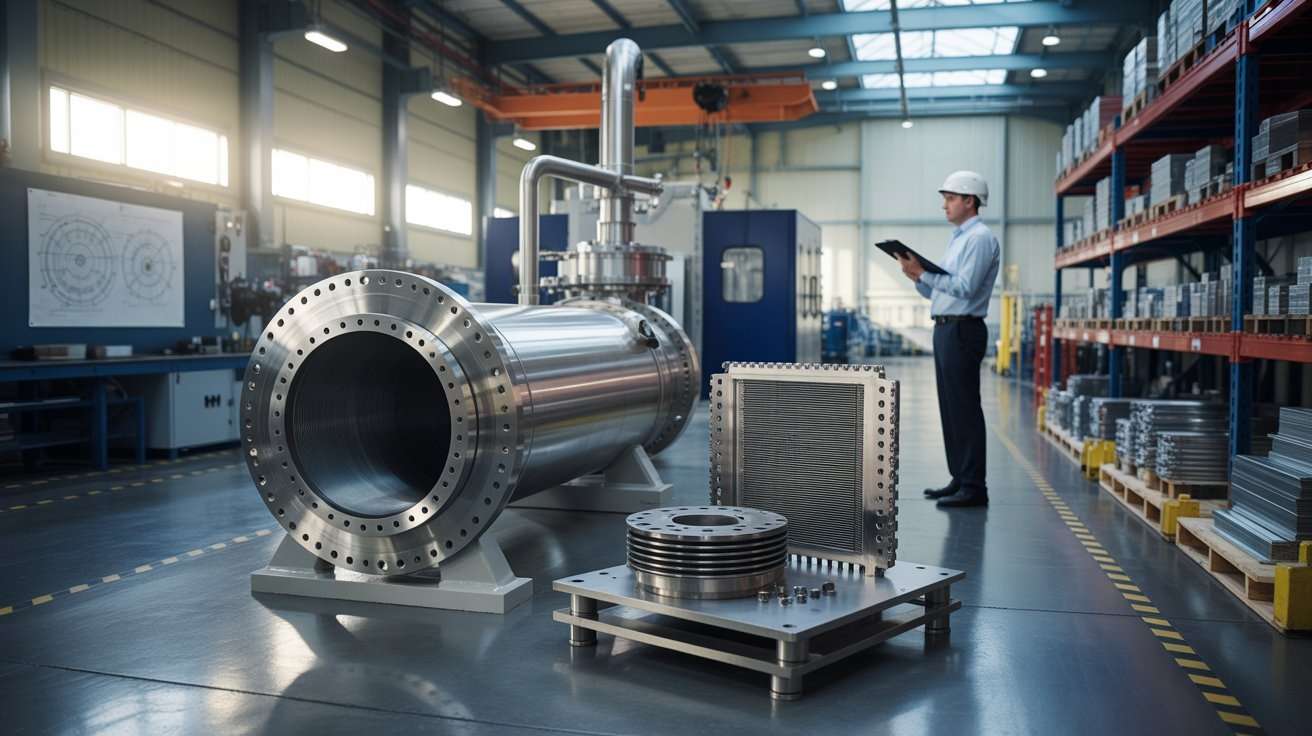
The shop infrastructure relevant to heat exchanger fabrication in GCC process facilities includes:
- Shell rolling and forming capacity covering the required diameter range and wall thickness for the shell class specified
- CNC tube sheet drilling with controlled pitch and pattern accuracy consistent with the TEMA class and tube OD specified
- Automatic tube-to-tube-sheet welding equipment for both strength-welded and seal-welded joint configurations
- Hydraulic tube expanding equipment for expanded-joint construction where the design requires it
- Horizontal hydrotest rigs with the pressure capacity required for the shell sizes and design pressures being fabricated
For larger process heat exchangers and air-cooled exchanger bundle assemblies, the manufacturer’s overhead crane capacity, bay clearance height, and logistics from shop to UAE or GCC project site are additional relevant inputs. A facility that can fabricate a 2,200 mm diameter shell but lacks the overhead crane capacity to safely rotate and inspect it before transport introduces schedule and cost risk that does not appear in any certification document.
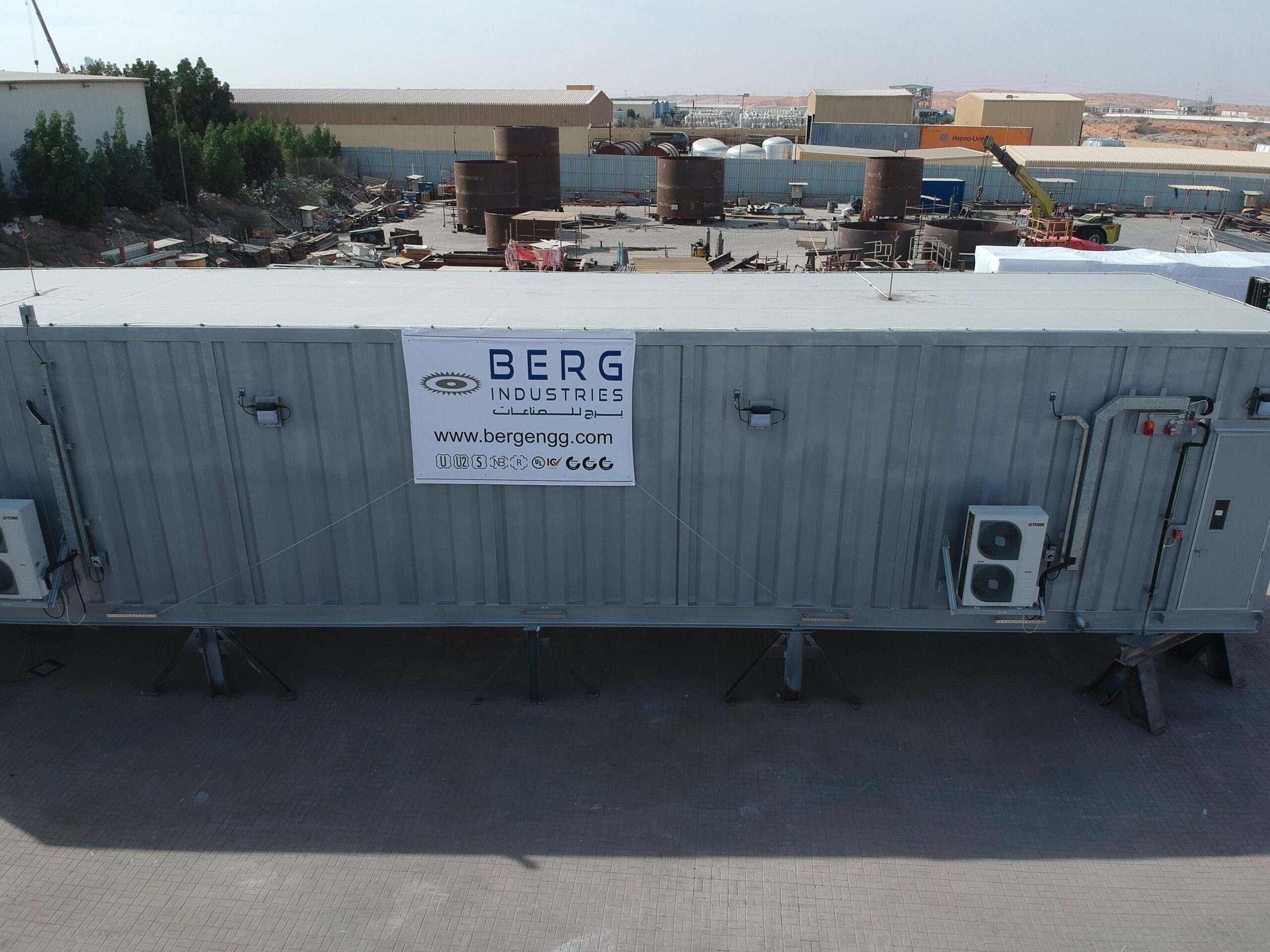
Berg Engineering‘s fabrication facilities in Ras Al Khaimah and Sharjah are configured for heavy static equipment fabrication, with shop infrastructure aligned to the shell diameters, wall thicknesses, pressure classes, and material grades that characterise oil and gas, power generation, and water treatment projects across the GCC. Details on fabrication scope and capacity for pressure vessel fabrication standards in the UAE are documented separately within the Berg technical library.
Quality Control, NDT, and Inspection Coordination
Heat exchanger fabrication involves pressure boundary welds subject to defined NDE requirements under ASME Section VIII, supplemented by client inspection and test plan (ITP) requirements. A manufacturer’s NDT capabilities and third-party inspection coordination process determine whether fabricated equipment clears hold points without rework and whether the completed documentation package satisfies UAE operator standards, including those applied within ADNOC Group projects.
The NDE methods applied during compliant heat exchanger fabrication are:
- Visual testing (VT) of all welds as the mandatory code baseline
- Radiographic testing (RT) for butt welds in shell courses and nozzle-to-shell connections per ASME Section VIII UW-11 requirements
- Ultrasonic testing (UT) as an alternative or supplement to RT, applied to thicker-wall weld joints where radiographic access is limited
- Liquid penetrant testing (PT) for austenitic stainless steel and nickel alloy weld surfaces
- Magnetic particle testing (MT) for carbon and low-alloy steel weld surface defect detection
- Hydrostatic pressure testing at 1.3 times the design pressure per ASME Section VIII UG-99 as the final integrity verification step
Confirm that the manufacturer coordinates with third-party inspection agencies relevant to UAE projects, including Bureau Veritas, TÜV Rheinland, Lloyd’s Register, SGS, and agencies pre-qualified with ADNOC Group operating entities. A standard ITP with defined hold points and witness points for client and third-party inspector participation should be available before fabrication begins.
Documentation That Accompanies the Equipment
A heat exchanger data book is the primary reference for asset integrity management, statutory inspection compliance, and insurance underwriting across the equipment’s operating life. A compliant data book delivered at mechanical completion includes: as-built fabrication drawings signed by a responsible engineer; MTRs for all pressure-retaining components traceable to heat and lot numbers; a weld map with NDE results assigned per seam; the full NDE report package; hydrostatic test records with witness signatures; the ASME Manufacturer’s Data Report Form U-1; ITP hold point release records; and nameplate data consistent with the ASME data report.
Confirm the full data book content list with the manufacturer at the time of enquiry. Incomplete data books at delivery create compliance gaps at the first statutory inspection and, in regulated UAE environments, may trigger hold-to-operate notices from the relevant inspection authority.
Sector Experience, Regional Project History, and Delivery Standards
General pressure vessel fabrication experience does not automatically transfer to the specific requirements of heat exchangers in process service. Tube bundle assembly tolerances, baffle spacing specifications, thermal expansion management under cyclic duty, and process fluid compatibility are application-specific competencies that develop through repeated exposure in the relevant sector. A static equipment manufacturer with a broad general fabrication record but limited heat exchanger project history in oil and gas or power service carries a different risk profile from one with a verified track record in those applications.
For UAE and GCC projects, sector-relevant experience covers:
- Oil and gas upstream and midstream: crude oil heat exchangers, produced water heat exchangers with high-chloride tube-side service, gas coolers and trim coolers in compression train service
- Refinery and petrochemical: overhead condensers, reboilers, reactor feed and effluent exchangers, process cooling systems in continuous process duty
- Power generation: feedwater heaters, condensate coolers, air-cooled exchangers for gas turbine support and thermal management of power generation infrastructure
- Water treatment and desalination: heat recovery exchangers for multi-effect distillation (MED), pre-treatment heat exchangers for reverse osmosis systems, brine heaters in multi-stage flash (MSF) plant service
Regional project history in the UAE provides verification beyond what a general reference list shows. Manufacturers with completed projects for ADNOC Group entities, Dubai Electricity and Water Authority (DEWA), Sharjah utilities, or major EPC contractors operating in the Emirates have demonstrated familiarity with UAE inspection coordination requirements, documentation standards, and GCC logistics from fabrication shop to project site. Request a GCC-filtered reference list and follow up directly with project contacts at EPC contractors or operating companies where possible.
Delivery reliability is a distinct evaluation point. Request a fabrication milestone plan at the quotation stage, broken down by material procurement, fit-up, welding, NDE, hydrotest, surface preparation, and transport. For exotic alloy specifications including DSS tube bundles or Hastelloy tube sheets, mill delivery from primary producers can materially extend the standard fabrication programme and should be surfaced by the manufacturer as a named programme contingency at the bid stage. A manufacturer who does not flag this is not managing schedule risk transparently on the buyer’s behalf. Confirm current workshop loading at the time of enquiry as part of the assessment.
The table below provides a structured comparison framework across eight primary selection criteria for procurement engineers evaluating heat exchanger companies in the UAE and GCC market.
| Evaluation Criterion | Strong Qualification | Acceptable Qualification | Minimum Threshold |
| ASME U Stamp | Valid, scope confirmed for heat exchanger type | Valid, scope requires separate verification | Must be confirmed and scoped before award |
| TEMA Class Compliance | Class R capability confirmed with WPS/PQR | Class B with documented upgrade path to R | Class must match project datasheet exactly |
| Thermal Design Capability | In-house, HTRI-rated, validated datasheet at bid | Client datasheet fabrication with third-party design review | Validated datasheet must precede fabrication release |
| Material Range | CS, SS 316L, DSS, CuNi 90/10, Inconel 625, Hastelloy C-276 | CS, SS, limited DSS with external procurement | Must cover all material types in project specification |
| NDT and Inspection | In-house VT/PT/MT, coordinated third-party RT/UT | Full third-party NDT with ITP-compliant coordination | ITP with defined hold and witness points mandatory |
| GCC Project History | 10 or more verified GCC references in relevant sector | 3 to 9 verifiable GCC references in relevant sector | At least one confirmed GCC sector reference |
| ISO 9001 Certification | Current, heat exchanger fabrication scope confirmed | Current, general manufacturing scope | Must be verified against heat exchanger scope |
| Delivery Reliability | Milestone schedule at bid stage, current load confirmed | Reference-based lead times with no formal schedule at bid | On-time delivery references required for evaluation |
For procurement teams also evaluating piping fabrication partners in conjunction with heat exchanger procurement, Berg’s scope for pipe spool and piping fabrication in the GCC covers complementary static equipment requirements within the same project envelope.
Post-Delivery Support, Spare Parts, and Total Cost of Ownership
The procurement relationship with a heat exchanger manufacturer in the UAE does not end at delivery. Heat exchangers in fouling, corrosive, or high-cycle thermal service require periodic tube bundle replacement, tube plugging, or full retubing as part of the facility maintenance programme. The manufacturer’s ability to support this work, whether by supplying replacement bundles to the original fabrication specification or by providing technical assistance during maintenance turnarounds, is a relevant criterion that is frequently omitted from initial evaluations.
A UAE-based manufacturer who retains as-built drawings and material records can supply replacement tube bundles with greater specification accuracy and shorter lead times than offshore suppliers who may not maintain long-term fabrication documentation for individual units shipped. For facilities where spare bundle availability affects turnaround schedule, regional proximity directly reduces lead time risk. Confirm at the time of enquiry whether the manufacturer retains as-built drawings and MTRs for long-term maintenance and reorder support as standard practice.
On total cost of ownership: a heat exchanger’s purchase price is one input in a calculation that also includes third-party inspection fees during fabrication, freight and import duties to UAE site, first statutory inspection findings, unplanned maintenance in service, and the eventual replacement cost at end of mechanical life. Process heat exchangers in oil and gas and power generation service are managed across fifteen-to-twenty-year operating cycles in most UAE facility asset integrity programmes. A unit fabricated to a higher standard that requires no unplanned intervention across the first decade of service represents a materially different value position from a lower-priced unit with an early retubing requirement.
When comparing quotations from heat exchanger companies, price comparison against a common technical specification is a valid procurement input. When specifications are not equivalent across bids, comparing prices without a rigorous technical review is not a cost-saving exercise. It is a deferred cost problem with a longer payment timeline than the original purchase order.
Frequently Asked Questions
What is the practical difference between TEMA Class R, B, and C for a process heat exchanger?
TEMA Class R applies to petroleum refinery and heavy chemical process service and requires the tightest fabrication tolerances on tube sheet drilling accuracy, baffle thickness, shell roundness, and corrosion allowance. Class B covers chemical process service at intermediate tolerances, and Class C is designed for moderate commercial applications where operating conditions are not severe.
How do I verify that a heat exchanger manufacturer's thermal design is valid before fabrication begins?
Request a rated thermal datasheet produced by the manufacturer's engineering team, showing the calculated heat duty against the required process duty, the fouling resistances assumed in the rating, and the design margin applied. HTRI Xchanger Suite is the recognised industry tool for shell-and-tube exchanger thermal rating and simulation.
What material qualifications should a heat exchanger manufacturer hold for GCC process applications?
For the range of service conditions in UAE oil and gas, power generation, and water treatment, a qualified manufacturer should hold WPS and PQR records for carbon steel (CS), stainless steel grades 304 and 316L, duplex stainless steel (DSS), Copper Nickel (CuNi 90/10) for seawater and high-chloride tube-side service, and nickel alloys including Inconel 625 and Hastelloy C-276 for severe corrosion duties.
What should a complete heat exchanger data book contain?
A compliant data book includes as-built fabrication drawings signed by a responsible engineer; mill test reports traceable to heat and lot numbers for all pressure-retaining components; a weld map with NDE results per seam; the full NDE report package covering all applicable methods (RT, UT, PT, MT); hydrostatic test records with witness signatures.
How does a UAE-based heat exchanger manufacturer compare to Asian or European suppliers for GCC projects?
A UAE-based heat exchanger manufacturer provides shorter transport lead times, lower freight and import duty exposure, and direct familiarity with UAE regulatory requirements, inspection authority coordination processes, and ADNOC Group pre-qualification procedures.