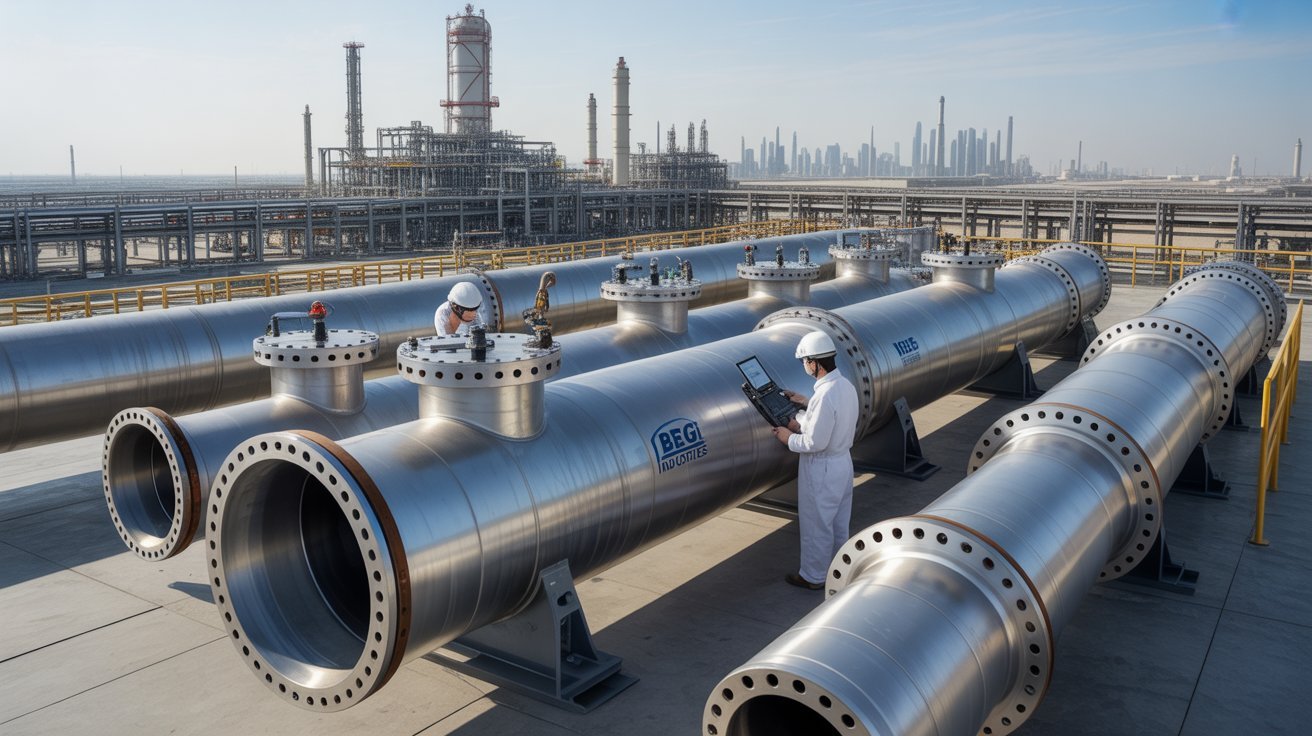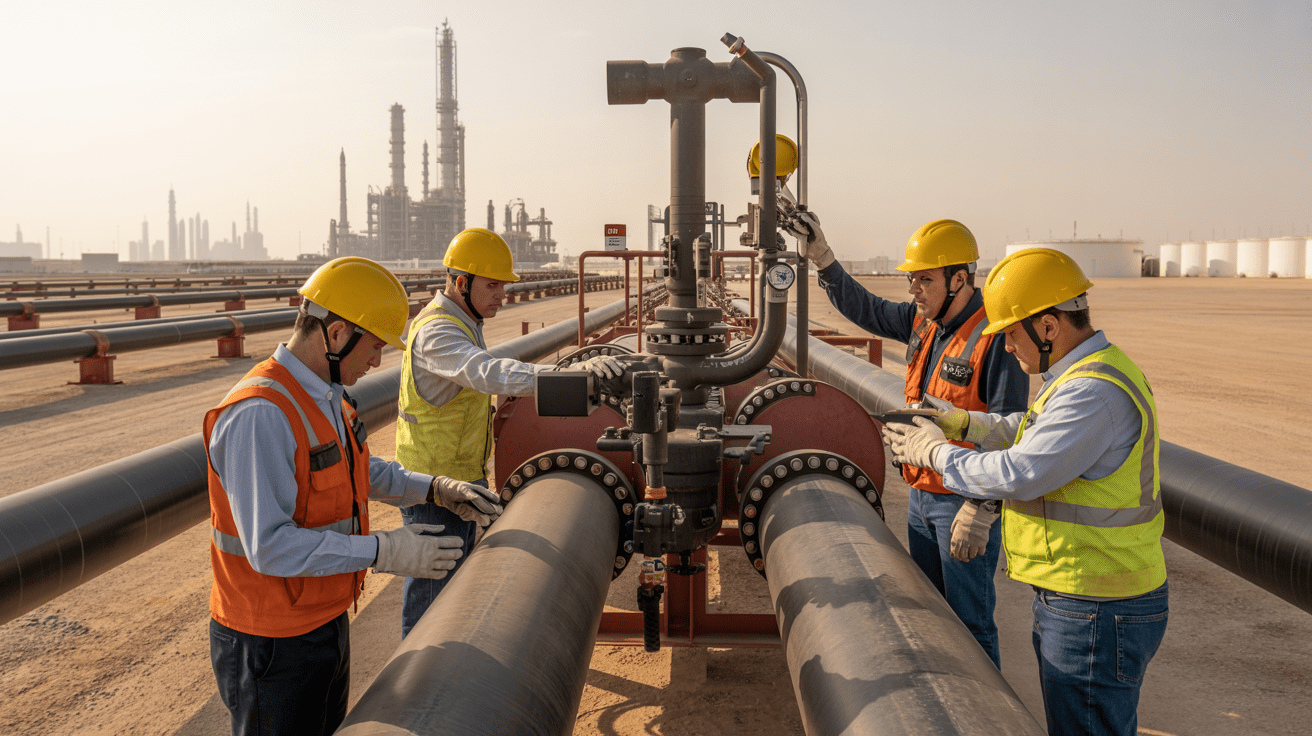
A pipeline operations team running a 48-inch crude export line in an Abu Dhabi concession area schedules a routine cleaning run. The pig stalls mid-run. Retrieval requires isolating a segment of the line, depressurising the system, and mobilising specialist equipment and personnel to the pig receiver location under unplanned conditions. Investigation confirms that the pig type was incompatible with the launcher configuration specified at the original design stage, a problem that propagated silently through procurement because no one in the project team had formally reviewed the relationship between the pig selection and the pig launcher design. The cost of the incident, measured in lost production, emergency mobilisation, and post-incident inspection, substantially exceeds the cost of specifying the correct launcher configuration at the engineering stage. For pipeline engineers, project managers, and procurement teams working on oil and gas pipelines across the GCC, understanding the types of pig launcher systems available and the engineering basis for selecting between them is a prerequisite for avoiding exactly this category of operational failure.
What a Pig Launcher Is and Why Configuration Matters
A pig launcher is a pressure-containing mechanical assembly installed at the upstream end of a pipeline segment that allows a pipeline pig, a device used for cleaning, inspection, or product separation, to be introduced into the live pipeline under controlled conditions, without depressurising or interrupting the flow through the main line. The pig launcher interfaces directly with the pipeline pressure envelope, meaning it is a pressure vessel in the regulatory and engineering sense of the term, not simply a mechanical fitting.
This classification has direct implications for design, fabrication, and certification. In the UAE and wider GCC oil and gas market, pig launcher assemblies fabricated for service in hydrocarbon pipelines must be designed and fabricated to applicable pressure vessel and pressure piping standards. ASME Section VIII Division 1 governs the barrel and closure design where the launcher is classified as a pressure vessel. The piping connections from the launcher to the main line and the kicker and equalisation lines are fabricated to ASME B31.3 for process piping or ASME B31.4 and B31.8 for liquid and gas pipeline systems respectively, depending on the operating service.
The configuration of the pig launcher determines which pig types it can accommodate, at what operational flow rates, under what pressure and temperature conditions, and with what level of operational complexity for the field crew executing the pigging run. Getting this configuration decision right at the design stage, before the equipment is fabricated and installed, is a fundamental engineering task that must be addressed by the pig launcher and receiver manufacturer in close coordination with the pipeline design engineer and the operations team responsible for the pigging programme.
Pipeline pigging systems that are designed without this coordination between launcher configuration and pig type produce the class of operational problems described in the opening paragraph of this article, with a frequency that is entirely preventable through proper front-end engineering.
Barrel Configuration: The Primary Design Variable
The barrel is the primary structural element of any pig launcher. It is the cylindrical pressure-containing shell into which the pig is loaded before the launch sequence begins. The barrel configuration, its diameter relative to the main line, its length, its orientation, and the geometry of the reducer connecting it to the main line, determines the fundamental operating characteristics of the launcher and establishes hard limits on the pig types and sizes that the system can handle.
The following barrel configuration types are used across oil and gas pipeline pigging systems in the GCC and globally. Each has specific engineering applications, operational characteristics, and selection criteria.
Standard Barrel Launcher
The standard barrel launcher is the baseline configuration for the majority of pig launcher applications in oil and gas pipelines. The barrel diameter is typically one or two nominal pipe sizes larger than the main pipeline diameter. This oversizing serves two functions: it provides the annular clearance required for the pig to be loaded into the barrel without binding against the barrel wall, and it allows the pig to be pressurised from behind using the kicker line flow before the main valve is opened, equalising the differential pressure across the pig before it enters the main pipeline bore.
Standard barrel launchers are used for routine pipeline cleaning systems applications, including foam pig runs for debris removal, gel pig runs for product separation, and standard cup pig runs for wax and deposit removal. They are also the baseline configuration for intelligent inline inspection (ILI) tool launching where the ILI tool geometry is compatible with the barrel bore and the reducer angle.
The barrel length is sized to accommodate the longest pig type in the operational pigging programme, plus a clearance allowance at the closure end for safe loading and door operation. For pipelines running multiple pig types on different operational schedules, the barrel must be sized to the longest tool in the programme, even if shorter pigs are run more frequently.
Oversized Barrel Launcher
The oversized barrel launcher uses a barrel diameter that is larger than the standard one or two size increment above the main line. This configuration is specified where the pig or ILI tool being launched has a larger body diameter than standard pigs for the same line size, or where the operational pigging programme includes tools with extended body length that cannot be accommodated in a standard barrel without an impractically long barrel assembly.
For intelligent inspection tools used on large-diameter pipelines, particularly MFL (magnetic flux leakage) or UT (ultrasonic testing) tools with sensor carrier bodies, the tool body diameter at the sensor section may approach or equal the main pipeline bore, requiring additional clearance in the launcher barrel for loading. The oversized barrel addresses this by providing additional annular clearance without requiring an excessively long barrel, which would create space and structural support constraints at the launcher site.
Static equipment manufacturers fabricating oversized barrel launchers must give particular attention to the reducer geometry connecting the oversized barrel to the main pipeline. The reducer angle, internal profile, and bore transition must be designed to allow the pig or tool to pass from the barrel into the main line bore without mechanical interference or damage to the pig sealing elements. For ILI tools, the reducer internal profile is typically specified by the inspection service provider and must be verified against the fabricated reducer before tool launch.
Closure Types and Their Operational Implications
The closure is the end fitting at the loading end of the launcher barrel. It must seal the barrel against the full operating pressure of the pipeline, allow safe and rapid opening for pig loading, and reliably reseal before pressure is applied. Closure type selection affects operational safety, maintenance frequency, loading time, and the minimum operating clearance required at the launcher site.
The table below summarises the primary closure types used on pig launcher assemblies in GCC oil and gas pipeline applications, with their key operational characteristics and selection considerations.
| Closure Type | Operating Mechanism | Pressure Rating | Key Advantage | Key Limitation |
| Threaded closure | Manual rotation of threaded ring or segmented thread | Full pipeline operating pressure | Simple design, low maintenance requirement | Labour-intensive for large-diameter launchers; thread wear requires periodic inspection |
| Quick-opening closure (QOC) | Interrupted thread or bayonet mechanism with quarter-turn or partial-turn operation | Full pipeline operating pressure | Fast opening and closing; reduced physical effort for large bore sizes | Higher initial cost; requires periodic inspection of thread and seal contact surfaces |
| Breech-lock closure | Segmented locking ring engaged by partial rotation | Full pipeline operating pressure | Very fast operation; suitable for high-frequency pigging programmes | Requires precise dimensional tolerancing; locking segment wear monitoring required |
| Flanged closure | Standard bolted flange connection | Full pipeline operating pressure | Simple and fully code-compliant; easy to replace sealing elements | Slow to open and close; unsuitable for high-frequency pigging operations |
| Hydraulic-assisted closure | Power-assisted opening and closing mechanism on large-bore closures | Full pipeline operating pressure | Reduces manual effort on large-diameter launchers; can be automated | Requires hydraulic power supply at launcher location; additional maintenance scope |
For oil and gas shutdown and maintenance works where pigging runs are infrequent and time is not the critical constraint, threaded or flanged closures are serviceable and low-maintenance. For operational pigging programmes running pigs at weekly or daily intervals on product separation or wax management applications, quick-opening closures reduce the manual time required per pig run and reduce the physical load on field operations personnel on hot-climate sites.
Seal integrity on the closure is a non-negotiable safety requirement. The seal must be rated for the full design pressure and temperature of the launcher, and the sealing element material must be chemically compatible with the pipeline product. Elastomeric seal selection for hydrocarbon service must account for the specific hydrocarbon composition, including the presence of H2S, CO2, or aromatic compounds that degrade standard elastomers at rates that would not be expected in clean hydrocarbon service.
Horizontal vs. Vertical Launcher Orientation
The physical orientation of the pig launcher barrel relative to grade level is a site-specific design decision with implications for pig loading procedures, structural support design, and operational safety.
Horizontal launchers, with the barrel running parallel to grade, are the standard configuration for the majority of onshore pipeline applications. Loading the pig into a horizontal barrel is a straightforward manual task for most pig types, with the pig supported by the barrel wall during loading. The launcher footprint at grade level is the primary space constraint, and the structural support design is a standard saddle and cradle configuration for the barrel, with a structural skid base if the launcher is specified as a skid-mounted unit.
Vertical launchers, with the barrel oriented perpendicular to grade, are used on offshore platforms and topside installations where the available footprint at grade is severely constrained and vertical space above the launcher is more accessible than horizontal space on the deck. Vertical launchers require different pig loading equipment and procedures, as the pig must be lifted into the vertical barrel from below before the closure is secured. For heavy ILI tools, this requires mechanical lifting assistance rather than manual loading.
Inclined barrel launchers, positioned at an angle between horizontal and vertical, are used in specific applications where the pipeline approach geometry, the available site area, or the drainage requirements during pig loading and retrieval favour an intermediate orientation. Draining the barrel before opening the closure is a safety procedure that removes residual product from the barrel before the pig is retrieved. On horizontal barrels, this requires a dedicated drain connection at the low point of the barrel. On inclined barrels, the orientation itself assists gravity drainage toward the low end.
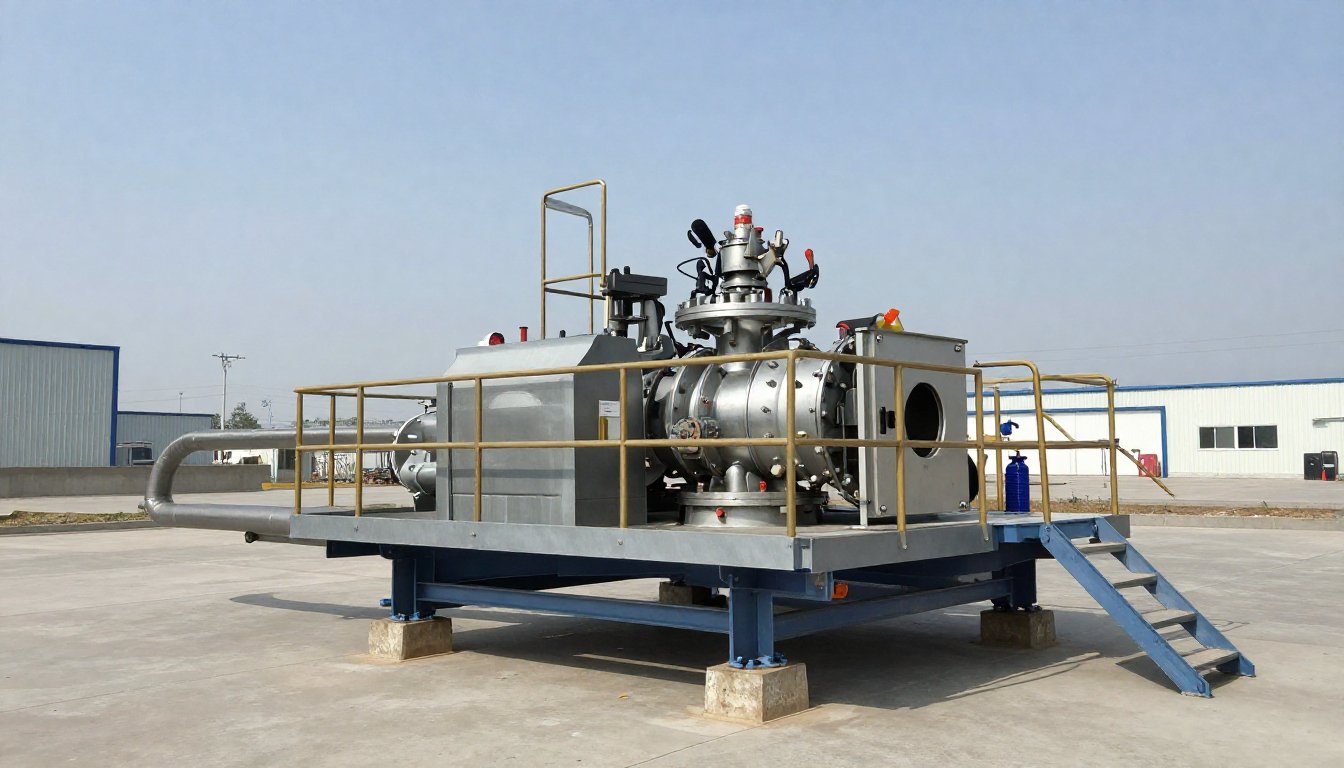
For pipeline pigging systems specified as skid-mounted packages, the launcher and receiver are mounted on a common structural steel skid that supports the barrel, the main isolation valve, the reducer, the kicker and equalisation line piping, the vent and drain connections, and the instrumentation provisions. Skid-mounted pipeline maintenance equipment packages are the standard supply format for GCC oil and gas projects, as they allow complete fabrication and testing of the launcher assembly at the fabrication facility before delivery to the pipeline site.
Specialised Pig Launcher Configurations for Specific Pipeline Services
Beyond the standard barrel and closure configurations, several specialised pig launcher types are used for specific pipeline service conditions, pig types, or operational requirements. Procurement engineers and pipeline engineers specifying pipeline pigging systems for non-standard applications should be aware of these configurations and the engineering basis for their selection.
Multi-Diameter Launcher
A multi-diameter launcher is configured to accommodate pigs for two different nominal pipeline diameters within a single launcher assembly. This configuration is used on pipeline systems where a reducing section in the main line requires pigs to be sized for the upstream and downstream diameter independently, but where a single launcher location is used to launch both pig sizes.
The multi-diameter launcher uses a stepped barrel with two different bore sections, each sized for the corresponding pig diameter. The loading procedure and pig retention mechanism must address both pig sizes without ambiguity. This configuration adds mechanical complexity compared to a single-diameter launcher and requires careful operational procedure development to prevent the wrong pig size from being loaded for a given pigging run.
Dual Barrel Launcher
A dual barrel launcher provides two independent barrels in a single launcher assembly, connected to the same main line. This configuration is used on high-frequency pigging applications where the pigging programme requires sequential pig launches at intervals too short to complete the pig loading and pressurisation sequence on a single barrel before the next launch is required. One barrel is being loaded and pressurised while the other is completing its launch sequence. Dual barrel launchers are used on gas pipelines with continuous liquid accumulation management requirements, where single-barrel launchers cannot maintain the pig launch frequency needed to prevent liquid buildup in the line.
ILI Tool Launcher
An ILI tool launcher is a standard barrel or oversized barrel launcher configured specifically for the launch and retrieval of intelligent inspection tools. The specific requirements of ILI tool launching distinguish it from standard cleaning pig operations in several respects.
The barrel internal surface finish must be compatible with the ILI tool’s sensor elements, particularly for UT tools where the transducer faces are in proximity to the barrel wall during loading. The reducer internal profile must match the ILI tool provider’s dimensional requirements to prevent sensor or mechanical damage during the transition from barrel bore to pipeline bore. The pig signal detector, a magnetic device that confirms the pig has passed a given point in the pipeline, must be installed at the correct location on the launcher to provide a reliable launch confirmation signal.
For oil and gas shutdown and maintenance works that include ILI inspection runs on pipelines with previous integrity concerns, the launcher configuration review is a specific pre-inspection engineering task. Confirming that the existing launcher configuration is compatible with the planned ILI tool before the inspection contractor mobilises to site avoids costly remobilisation or field modification of the launcher during the inspection window.
Key Engineering and Fabrication Standards for Pig Launcher Assemblies
Pig launcher assemblies are pressure-containing equipment with direct implications for pipeline system safety. The fabrication standards applicable to launcher barrels, closures, and associated piping determine the level of engineering assurance the client and the operating company can place in the equipment’s integrity over its service life.
The following standards apply to pig launcher fabrication for oil and gas pipeline service in the UAE and GCC:
- ASME Section VIII Division 1 governs the design and fabrication of the launcher barrel and closure where classified as an unfired pressure vessel, including the design pressure and temperature basis, the material specification, the minimum wall thickness calculation, and the required pressure test
- ASME B31.3 applies to the process piping integrated within the launcher skid package, including the kicker line, equalisation line, vent, and drain connections, with weld documentation, material traceability, and hydrostatic test records required for each piping circuit
- ASME B31.4 or B31.8 governs the pipeline connection piping where the launcher is a direct component of a liquid or gas transmission pipeline system respectively
- Material specifications must use correct industry designations: carbon steel (CS) to ASTM A516 or A105 for standard service; 316L stainless steel (SS) for sour or corrosive service; duplex stainless steel (DSS) for high-chloride environments such as seawater injection or offshore applications
A certified static equipment manufacturer fabricating pig launcher assemblies for ADNOC-governed projects or projects with independent lender engineer requirements will maintain ASME U Stamp certification, enabling the issuance of ASME Code stamp documentation for the pressure vessel components within the launcher assembly. This certification is a procurement requirement on a significant proportion of UAE oil and gas capital projects and must be confirmed during vendor qualification, not assumed from vendor marketing materials.
The full inspection and test scope for a pig launcher assembly fabricated to these standards includes dimensional inspection against approved fabrication drawings, weld visual inspection and NDE to the specified weld examination category, hydrostatic pressure test of the completed barrel and closure assembly to 1.5 times the design pressure with a documented hold time, coating inspection for external and internal corrosion protection systems, and FAT of the complete skid package including functional verification of all valves, instrumentation, and pressure safety devices.
Berg Engineering’s Pig Launcher and Static Equipment Fabrication Capabilities
Berg Engineering designs and fabricates pig launcher and receiver assemblies as part of its static equipment and skid package manufacturing scope, from facilities in Ras Al Khaimah and Sharjah. As an established static equipment manufacturer and pig launcher & receiver manufacturer in the UAE, Berg’s fabrication scope covers standard barrel and oversized barrel launcher configurations, horizontal and vertical orientations, skid-mounted packages with integrated kicker and equalisation piping, and complete pipeline pigging systems including paired launcher and receiver assemblies on a common skid or separate structural steel frames.
Berg holds ASME U Stamp and NB certification, enabling the fabrication of launcher barrel and closure assemblies to ASME Section VIII Division 1 with full Code stamp documentation. Associated process piping within the launcher skid is fabricated to ASME B31.3 under Berg’s quality management programme, with weld documentation, material certifications, and hydrostatic test records generated within the Berg quality system. ISO 9001 certification covers the full design and fabrication scope, with ITPs structured to accommodate third-party inspection witness requirements from ADNOC-approved inspection agencies.
For oil and gas shutdown and maintenance works requiring replacement or upgrade of existing pig launcher assemblies, Berg’s engineering team can assess the existing installation configuration and design a replacement unit that interfaces with the existing pipeline connection geometry and site structural provisions, reducing the civil and piping modification scope required during the maintenance window.
Berg’s static equipment fabrication scope extends to pressure vessels, surge vessels, storage tanks, and chemical injection skid packages for oil and gas and infrastructure applications. For projects combining pipeline pigging systems with chemical injection or metering requirements on the same pipeline segment, Berg coordinates the complete skid package scope under a unified engineering team, ensuring that the interface connections, structural footprint, and instrumentation conventions are aligned across all packages from the start of detailed design.
Frequently Asked Questions
What pressure standards apply to pig launcher fabrication for UAE oil and gas projects?
Pig launcher assemblies in UAE oil and gas pipeline service are fabricated to ASME Section VIII Division 1 for the barrel and closure pressure vessel components, with ASME U Stamp certification required on projects under ADNOC jurisdiction or where independent lender engineers are involved. Piping within the launcher skid package is fabricated to ASME B31.3 for process piping service or ASME B31.4 and B31.8 for liquid and gas pipeline service respectively. Material specifications must align with the pipeline fluid service: carbon steel (CS) for standard hydrocarbon service, 316L stainless steel (SS) for corrosive or chemical injection service, and duplex stainless steel (DSS) for high-chloride or sour service environments.
What is the difference between a standard barrel and an oversized barrel pig launcher?
A standard barrel pig launcher uses a barrel diameter one or two nominal pipe sizes larger than the main pipeline, providing clearance for pig loading and pressurisation before launch. An oversized barrel launcher uses a larger diameter increment, specified where the pig or inline inspection tool body diameter requires additional annular clearance for loading, or where the tool body length requires a longer barrel that a standard diameter configuration cannot support without an impractical structural span. The reducer connecting the barrel to the main pipeline must be designed to accommodate the pig transition in both cases, with the internal profile verified against the specific pig or tool geometry before fabrication is finalised.
What should be included in a Factory Acceptance Test for a pig launcher skid package?
A FAT for a pig launcher skid package should include dimensional inspection against approved fabrication drawings, hydrostatic pressure test of the barrel and closure assembly to 1.5 times the design pressure with a documented hold time and acceptance criteria, functional testing of all manual and actuated valves on the skid, verification of all pressure gauge and transmitter calibrations, visual inspection of the internal and external coating systems, NDE review for all pressure-containing welds as specified in the weld examination category, and a completeness check against the material take-off and shipping list. The FAT record, including signed test sheets and punch list close-out documentation, forms part of the mechanical completion handover package.
How is a pig launcher sized for an intelligent inline inspection tool?
A pig launcher for intelligent inline inspection (ILI) tool launching is sized based on the specific tool body diameter, tool body length, and centre of gravity data provided by the inspection service provider. The barrel bore must provide sufficient annular clearance around the tool body for loading without damaging sensor elements. The barrel length must accommodate the full tool body length plus the minimum clearance specified by the tool provider at the closure end. The reducer internal profile must match the ILI tool provider's dimensional transition requirements. These parameters are specific to the individual tool type and must be confirmed with the inspection service provider before the launcher design is finalised, not assumed from generic pig sizing tables.
What is the role of a pig launcher in oil and gas shutdown and maintenance works?
In oil and gas shutdown and maintenance works, the pig launcher provides the controlled access point for introducing cleaning pigs, gel slugs, or inspection tools into the pipeline during planned maintenance windows. Before a maintenance pig run, the launcher is inspected for closure seal condition, valve operability, and kicker line integrity. For pipelines that have not been pigged for extended periods, the first run may use a foam pig or gauging plate pig to assess the internal condition of the line and identify any bore restrictions before a more aggressive cleaning pig or ILI tool is launched. The pig launcher condition directly affects the reliability of the pigging programme, and its inspection is a defined hold point within the pipeline maintenance equipment inspection checklist for scheduled turnarounds.