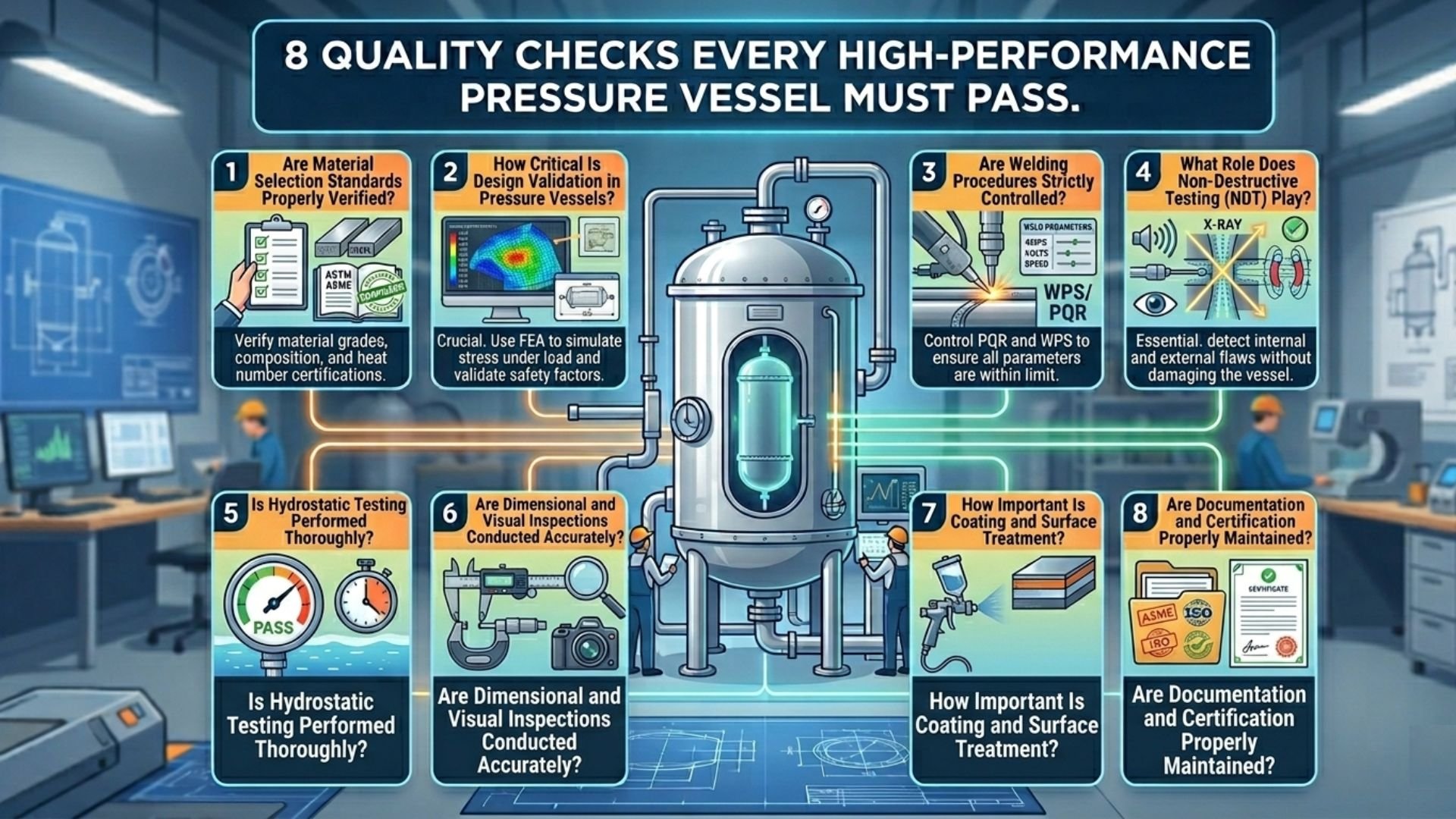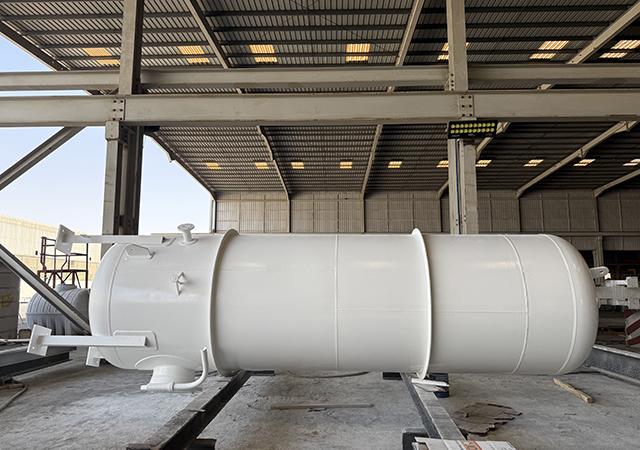
Carbon steel SA-516 Grade 70 is the most widely specified base material for ASME pressure vessels in oil and gas service. It is also the material most frequently applied outside its appropriate service boundaries. When pressure vessels manufacturer in UAE receives any project specification, the material callout on the datasheet is often treated as a confirmed decision rather than a starting point for engineering reviews. For high-pressure applications, that assumption carries risk. Material selection requires systematic verification against fluid chemistry, operating temperature, cyclic loading profile, and the applicable ASME code requirements before fabrication drawings are released.
The cost of a material selection error in high-pressure vessel fabrication does not appear at the fabrication stage. It appears in service: as accelerated corrosion in an environment the specified material cannot tolerate, stress corrosion cracking in a chloride-containing fluid at operating temperature, hydrogen embrittlement in elevated-temperature hydrogen service, or mechanical failure at a pressure boundary weld. By the time these failure modes are identified, the vessel has been installed and commissioned. Correction requires system shutdown, vessel removal, and in regulated UAE environments, inspection authority clearance before the system can return to operation.
This blog covers the principal materials used in high-pressure vessel fabrication, the service conditions each is suited to, and the technical criteria that a qualified fabrication partner should apply when verifying and finalising a material specification.
What Material Selection Requires From a Pressure Vessel Manufacturer in UAE
Material selection for pressure vessels is a multi-variable engineering decision, not a catalogue reference. The qualified pressure vessels manufacturer in UAE evaluates four parameters that collectively define what the vessel’s pressure boundary must withstand across its operating life. Understanding these parameters is the basis for any technically defensible material specification.
The first parameter is fluid service: the chemical composition of the process fluid, its corrosivity, and whether it contains contaminants that activate specific degradation mechanisms. Hydrogen sulphide in sour gas service, chloride ions in aqueous and produced water environments, and hydrogen partial pressure in refinery reactor service are examples of fluid chemistry variables that directly determine which materials are permissible and which ASME or NACE compliance requirements apply before fabrication begins.
The second parameter is the operating temperature range, covering both the maximum operating temperature and the minimum design metal temperature (MDMT). MDMT governs impact testing requirements under ASME Section VIII for materials in low-temperature service where brittle fracture risk increases. Maximum operating temperature determines which alloy systems retain adequate strength and oxidation resistance under sustained loading.
The third parameter is design pressure and loading profile. ASME Section VIII Division 2 applies alternative design rules for high-pressure applications, uses more detailed fatigue analysis for cyclic service, and permits reduced shell wall thickness at equivalent pressure ratings compared to Division 1, in exchange for tighter fabrication inspection requirements. For ASME industrial pressure vessels in sustained high-pressure service, the division selection affects both the material allowable stress values used in design calculations and the NDE requirements applied during fabrication.
The fourth parameter is the external environment. In the UAE, coastal and offshore facilities expose external vessel surfaces to salt-laden air and high humidity, accelerating external corrosion on carbon steel shells and affecting insulation system performance. Ambient temperatures regularly exceeding 45°C during summer months at RAK and Sharjah facilities affect thermal differential calculations between the vessel shell and internal process fluid, as well as relief valve sizing assumptions. Surge vessels manufacturing companies in UAE working in pipeline and water system service apply the same ASME framework as pressure vessel fabricators, with material selection driven by pipeline fluid chemistry and the transient pressure conditions the surge vessel is designed to absorb. The materials covered below span the full range from standard carbon steel through to nickel alloys, each suited to a different position within that service envelope.
Carbon Steel and Low Alloy Steel: The Baseline for High-Pressure Service
Carbon steel covers the majority of moderate-temperature, low-to-moderate corrosivity applications in oil and gas, power generation, and utility pressure vessel service across the GCC. It remains the starting point for any material evaluation: either the service conditions confirm that carbon steel is the appropriate specification, or they define precisely which upgrade is required and why. Understanding both the applicable carbon steel grades and the boundaries of their service range is the functional basis for making that determination.
SA-516, SA-387, and Grade Selection Under ASME Section VIII
SA-516 Grade 70 is the ASME specification most commonly applied to pressure vessel shells, heads, and nozzle reinforcing pads in general oil and gas service. The Grade 70 designation defines the minimum tensile strength class: 70 ksi minimum tensile and 38 ksi minimum yield for standard plate thickness ranges. SA-516 Grade 60 provides a lower strength class at the same chemical composition, used where design pressure is lower and reduced wall thickness is not a fabrication priority. Both are carbon-manganese steels, normalised to improve low-temperature toughness, and suitable for service from the MDMT established by ASME impact test exemption curves down to the minimum design metal temperature verified by Charpy impact testing where required by code.
Carbon steel SA-516 is not suitable for the following service conditions, regardless of corrosion allowance applied:
- Hydrogen service at elevated temperature and partial pressure, where the Nelson curves defined in API 941 establish the temperature-pressure boundary above which carbon steel is susceptible to high-temperature hydrogen attack (HTHA), involving decarburisation and intergranular cracking that cannot be detected by standard NDT methods until failure is imminent
- Sour service containing H2S above the threshold concentrations defined in NACE MR0175 / ISO 15156, which mandates hardness limits and heat treatment controls affecting both base material selection and weld procedure qualification for all pressure-retaining components
- Elevated temperature service above approximately 400°C under sustained loading, where carbon steel experiences accelerating creep rates and reduced ASME allowable stress values that make it unsuitable for structural pressure containment without material upgrade
For high-temperature applications where carbon steel approaches or exceeds these limits, low alloy chromium-molybdenum steels under ASME specification SA-387 provide the appropriate upgrade. SA-387 Grade 11 (1.25Cr-0.5Mo) and Grade 22 (2.25Cr-1Mo) are the most widely applied Cr-Mo grades in refinery and power generation pressure vessel service, offering improved high-temperature strength and resistance to hydrogen attack in accordance with the Nelson curves for their respective alloy content. SA-387 Grade 91 (9Cr-1Mo-V) covers the highest temperature range and is specified for advanced power generation vessels and reactors where operating temperatures exceed the practical range of lower Cr-Mo grades.
All low alloy Cr-Mo steels under SA-387 require post-weld heat treatment (PWHT) to relieve fabrication residual stresses and restore the heat-affected zone microstructure. PWHT soak temperature range and hold time are defined by ASME Section VIII and the applicable welding procedure specification. A pressure vessel fabrication partner must hold documented PWHT procedures and demonstrate furnace or localised induction heating capability for the vessel size and wall thickness being fabricated. Confirm this capability before order placement for any Cr-Mo vessel specification.
Stainless Steel Grades in ASME Pressure Vessel Fabrication
Stainless steel grades are specified for pressure vessels where the process fluid or external operating environment produces unacceptable corrosion rates in carbon steel, where product purity requirements prohibit ferrous contamination, or where fluid chemistry and temperature fall outside the range carbon steel can accommodate with standard corrosion allowance. The selection between stainless grades is not interchangeable. The difference between specifying 304 and 316L in a given chloride-containing service environment has direct consequences for vessel service life and inspection findings at the first statutory review cycle.
ASME SA-240 is the plate specification governing stainless steel for pressure vessel fabrication. The principal grades used in UAE industrial pressure vessel fabrication are:
- SA-240 Grade 304 and 304L: austenitic stainless steel with an 18% chromium and 8% nickel nominal composition, providing general corrosion resistance in atmospheric, aqueous, and mild chemical environments. The L designation denotes low carbon content, limiting carbide precipitation in the weld heat-affected zone and improving weld corrosion resistance in service. Specified for water treatment vessels, chemical injection skid vessels, and general process applications where chloride concentration is low and operating temperature is moderate.
- SA-240 Grade 316 and 316L: the addition of 2 to 3% molybdenum to the standard 18-8 austenitic composition provides meaningfully improved resistance to chloride pitting and crevice corrosion compared to Grade 304. SA-240 316L is the dominant stainless grade for UAE coastal and offshore process vessels where seawater contact or chloride-bearing process fluids are present, and is the standard specification for pharmaceutical process vessels and food-grade equipment in UAE manufacturing facilities, typically with electropolished internal surfaces and full material traceability per ASME SA-240.
- SA-240 Grade 321: a titanium-stabilized austenitic grade specified for service above 425°C where prolonged high-temperature exposure creates sensitization risk in the weld heat-affected zone of standard 304 or 316 vessels. The titanium addition preferentially combines with carbon, preventing chromium carbide precipitation and preserving corrosion resistance at the grain boundary in sustained high-temperature service.
The performance limitation shared by all standard austenitic stainless grades in high-pressure and high-chloride environments is susceptibility to stress corrosion cracking (SCC). SA-240 316L is not immune to chloride SCC and is not the appropriate selection for high-pressure vessels in concentrated chloride service or at elevated temperatures where SCC risk has been established for that fluid chemistry. For ASME pressure vessels in pharmaceutical, food processing, and water treatment service across UAE manufacturing facilities, 316L with full SA-240 material certification and WPS/PQR records covering austenitic grades is the baseline specification. Berg Engineering’s static equipment fabrication scope includes stainless steel pressure vessels fabricated to ASME Section VIII Division 1 for these applications.
Duplex and Super Duplex Stainless Steel for Corrosive High-Pressure Applications
Duplex stainless steel occupies the material selection position where standard austenitic grades reach their service limits: specifically in high-chloride, high-pressure environments where SCC risk in 316L is unacceptable, and where the cost of solid nickel alloy construction is not justified by the degree of service severity. Its dual-phase microstructure and higher yield strength create a performance and design efficiency profile that neither austenitic stainless nor carbon steel can replicate in this service category.
Duplex 2205, designated UNS S31803 or S32205 under ASME, maintains a microstructure of approximately equal austenite and ferrite fractions. This dual-phase structure provides chloride stress corrosion cracking resistance substantially superior to 316L, alongside a yield strength approximately twice that of standard austenitic grades. The higher yield strength translates to reduced wall thickness at equivalent pressure rating, which has practical fabrication and weight implications for large vessels and for vessels where transport weight is a project logistics constraint. The pitting resistance equivalent number (PREN) for duplex 2205 falls in the range of 32 to 36, confirming resistance to chloride pitting in environments that would cause localised corrosion in 316L.
Super duplex grades, primarily SAF 2507 (UNS S32750) and Zeron 100 (UNS S32760), extend the duplex performance envelope to more aggressive service conditions. SAF 2507 carries a PREN above 40, making it suitable for seawater service at temperatures up to approximately 80°C and for high-pressure vessels in produced water and offshore-related service where chloride concentrations are high and H2S partial pressure may be present at low levels. UAE offshore facilities and pipeline systems serving coastal processing plants have progressively specified SAF 2507 for pressure vessels and piping components where duplex 2205 provides insufficient corrosion margin for the specific fluid chemistry.
Fabricating duplex and super duplex vessels requires welding procedures qualified specifically for the duplex microstructure. Heat input control during welding is critical: excessive heat input promotes sigma phase precipitation and ferrite-to-austenite ratio imbalance in the weld heat-affected zone, reducing corrosion resistance and impact toughness in the fabricated joint. A pressure vessel manufacturer without qualified duplex WPS and PQR documentation cannot fabricate duplex vessels to ASME Section VIII requirements. The phase balance in completed welds should be verified by ferrite measurement or metallographic examination as part of the weld procedure qualification. Confirm WPS and PQR coverage for duplex and super duplex grades before placing any order involving these material specifications.
Nickel Alloys and Clad Construction for Severe Service Conditions
Nickel alloys are specified when process fluid chemistry exceeds the corrosion resistance capability of the stainless and duplex grades, when operating temperature places the vessel outside the range those materials sustain with adequate mechanical properties, or when process licensor or regulatory requirements mandate a specific alloy system for the service. The principal nickel alloy grades used in ASME pressure vessel fabrication for UAE high-pressure service are technically distinct and each addresses a different primary failure mechanism.
Inconel 625 (UNS N06625) is a nickel-chromium-molybdenum alloy with niobium additions providing solid solution strengthening. It offers corrosion resistance in both oxidising and reducing environments, resistance to pitting and crevice corrosion in seawater at elevated temperature, and mechanical property retention at temperatures that would cause creep in carbon and low alloy steels. It is specified for high-pressure vessels in offshore oil and gas service, chemical process vessels handling mixed acid streams, and nozzle and tubesheets in heat exchangers where the process-side fluid is highly corrosive. ASME specification for Inconel 625 plate is SB-443; for tube and pipe, SB-444.
Hastelloy C-276 (UNS N10276) is a nickel-molybdenum-chromium alloy developed specifically for resistance to strong reducing acids, wet chlorine gas, and chloride-containing solutions in reducing conditions. Its molybdenum content of 15 to 17% provides corrosion resistance in environments that would attack both austenitic stainless steels and Inconel grades. C-276 is specified for pressure vessels handling hydrochloric acid, mixed acid streams in chemical processing, and chlorine-containing process fluids. ASME specification for C-276 plate is SB-575.
Monel 400 (UNS N04400), a nickel-copper alloy, provides established corrosion resistance in hydrofluoric acid service and in seawater at moderate temperatures. It remains relevant for HF alkylation unit vessels in refinery service and certain sour water applications where its specific corrosion resistance profile matches the service requirements.
Clad Construction as an Engineering and Cost-Management Solution
Full nickel alloy pressure vessel construction is appropriate where the process fluid contacts all internal surfaces at conditions requiring alloy performance throughout the vessel wall. For vessels where the primary design driver is the mechanical strength required to contain high pressure, and corrosion resistance is required only at the internal process-contact surface, clad construction provides a technically sound alternative at lower material cost than solid alloy fabrication.
Clad vessels use a carbon steel or low alloy steel base plate for the structural wall thickness, bonded to a corrosion-resistant alloy cladding layer on the internal process-contact surface. Cladding materials include 316L stainless, duplex 2205, Inconel 625, and Hastelloy C-276, bonded to the backing plate by roll bonding or explosion bonding processes. ASME Section VIII Division 1 Part UCL governs the design and fabrication of clad vessels, defining minimum cladding thickness requirements, bond integrity testing methods, and weld overlay requirements at nozzle connections and internal attachments where cladding continuity must be maintained.
For UAE industrial pressure vessels in service environments where carbon steel provides the mechanical design basis but internal fluid chemistry requires alloy corrosion resistance at the wetted surface, clad construction offers a material cost advantage over solid alloy fabrication. The actual cost differential depends on alloy type, cladding thickness, vessel geometry, and nozzle configuration, and should be evaluated by the fabrication partner against the full vessel scope and service specification. A qualified pressure vessel fabrication partner should be able to present the design basis for a clad versus solid alloy recommendation with reference to the applicable ASME UCL requirements.
Material Selection in Practice: A Decision Framework for Procurement and Engineering Teams
Translating service conditions into a material specification that a fabrication shop can source, certify, weld, and deliver to the applicable ASME code is the practical endpoint of any material selection exercise. The verification sequence below reflects how a technically qualified pressure vessel manufacturer in UAE approaches material finalisation before fabrication drawings are issued.
For procurement engineers working with a pressure vessel or surge vessel fabrication partner on material review, the following steps apply regardless of the initial material callout on the project datasheet:
- Verify the process fluid composition against known degradation mechanisms for each candidate material: chloride content against SCC threshold concentrations for stainless and duplex grades; H2S partial pressure against NACE MR0175 sour service thresholds; hydrogen partial pressure against the API 941 Nelson curves for carbon and low alloy steel grades
- Confirm the operating temperature range against the ASME Section II Part D allowable stress tables for the specified material, and verify that the MDMT is achievable under ASME impact test exemption criteria or that impact testing is included in the fabrication ITP
- Confirm PWHT requirements under ASME Section VIII and the applicable fluid service classification, and verify that the fabrication shop holds documented PWHT procedures and capable equipment for the vessel geometry and wall thickness
- Confirm WPS and PQR coverage for the specified base material, including any dissimilar metal welds between vessel shell, nozzle, and cladding materials
- Confirm material traceability documentation standards for all pressure-retaining components, including mill test reports traceable to heat and lot numbers per the applicable ASME material specification, before purchase orders are placed to the material supplier
The comparison table below summarises the principal materials used in high-pressure vessel fabrication against the service parameters that determine their appropriate application range.
| Material | ASME Specification | Suitable Service Temp Range | Primary Application in UAE/GCC Service | Key Service Limitation |
| Carbon Steel SA-516 Gr 70 | SA-516 | MDMT to approx. 400°C | General oil and gas, utilities, non-corrosive process | Not suitable for sour service above NACE limits or H2 service above Nelson curve limits |
| Cr-Mo Steel SA-387 Gr 22 | SA-387 | Up to approx. 580°C | Refinery reactors, high-temperature process, hydrogen service | PWHT mandatory; qualified low-hydrogen welding procedures required |
| Stainless Steel SA-240 316L | SA-240 | MDMT to approx. 870°C (oxidising) | Aqueous corrosive service, pharmaceutical, water treatment | Susceptible to chloride SCC above threshold concentrations and temperatures |
| Duplex 2205 | SA-240 | MDMT to approx. 300°C (phase stability limit) | High-chloride process, produced water, coastal facilities | Sigma phase risk above 300°C; welding requires heat input control and WPS/PQR qualification |
| Super Duplex SAF 2507 | SA-240 | MDMT to approx. 280°C (phase stability limit) | Seawater service, offshore produced water, high-chloride high-pressure | Limited pool of qualified fabricators; higher material and fabrication cost than 2205 |
| Inconel 625 | SB-443 (plate) | Cryogenic to approx. 980°C | Offshore vessels, mixed acid service, severe corrosion in reducing environments | High material cost; nickel alloy WPS/PQR qualification required |
| Hastelloy C-276 | SB-575 (plate) | Cryogenic to approx. 870°C | HCl service, wet chlorine gas, reducing acid streams | Very high material cost; specified only where service severity justifies it |
| Clad: CS base with alloy cladding | UCL (ASME VIII Div 1) | Per base plate rating | Cost-managed alternative to solid alloy where mechanical basis is CS | Bond integrity testing mandatory; nozzle cladding continuity is a fabrication-critical requirement |
For ASME pressure vessels and surge vessel fabrication in UAE oil and gas, pipeline, and utility service, Berg Engineering holds fabrication certifications and documented WPS/PQR records across the material range covered in this guide, with facilities in Ras Al Khaimah and Sharjah qualified for carbon steel, low alloy, stainless, duplex, and nickel alloy pressure vessel fabrication to ASME Section VIII Division 1 and Division 2.
Frequently Asked Questions
When should duplex stainless steel be specified instead of 316L for a pressure vessel?
Duplex stainless steel should be specified when chloride concentration or operating temperature creates a stress corrosion cracking risk that 316L cannot manage across the vessel's design life. Duplex 2205 provides significantly greater chloride SCC resistance than 316L and a yield strength approximately twice that of standard austenitic grades.
What is the difference between ASME Section VIII Division 1 and Division 2 for high-pressure vessel fabrication?
Division 1 uses design-by-rule methodology with prescribed wall thickness formulas and defined safety factors. Division 2 applies design-by-analysis with higher allowable stresses, requiring detailed fatigue analysis and 100 percent radiographic examination of all pressure boundary welds. Division 2 is selected where reduced wall thickness provides a tangible engineering advantage.
What are the material requirements for sour service pressure vessels under NACE MR0175?
NACE MR0175 / ISO 15156 requires hardness limits on base metal, weld metal, and heat-affected zone for carbon and low alloy steel vessels in H2S-containing service, along with PWHT where required to achieve compliance. Applicable limits must be verified against the actual fluid chemistry before material selection is finalised.
What is clad pressure vessel construction and when is it the appropriate specification?
Clad construction uses a carbon steel base plate for structural wall thickness bonded to a corrosion-resistant alloy layer on the internal process-contact surface. It is appropriate where carbon steel provides the mechanical design basis but internal fluid chemistry requires alloy corrosion resistance, and solid alloy fabrication cost is not warranted.
How does a qualified pressure vessel manufacturer in Dubai or RAK verify material suitability before fabrication begins?
A qualified manufacturer verifies material suitability by evaluating fluid chemistry against corrosion mechanisms, confirming operating temperature against ASME Section II Part D allowable stress values, reviewing MDMT requirements, and confirming WPS and PQR coverage for all specified materials. Mill test reports must be traceable to heat and lot numbers before fabrication begins.